


Accord and satisfaction is a legal doctrine used to settle a disputed debt, contract obligation, or claim by accepting something different from what was originally owed. It often appears in contract disputes, payment disagreements, debt settlements, construction conflicts, business invoice disputes, and “paid in full” check situations.
The idea has two parts. The accord is the new agreement between the parties. The satisfaction is the performance of that new agreement. Once the satisfaction happens, the original claim or obligation may be discharged.
For example, if a contractor claims a customer owes $10,000, but the customer disputes the quality of the work, both sides may agree that $7,000 will settle the dispute in full. The agreement to accept $7,000 is the accord. The actual payment of $7,000 is the satisfaction.
Accord and satisfaction can be useful because it helps parties resolve disputes without a lawsuit. However, it can also create risk if the agreement is unclear, if one side does not understand the settlement language, or if a party accidentally accepts a payment marked “paid in full.”
Legal note: This article gives general information only. It is not legal advice. The rules for accord and satisfaction vary by jurisdiction, contract type, and case facts.

What Is Accord and Satisfaction?
Accord and satisfaction means the parties agree to settle an existing obligation by accepting a new or different performance instead of the original performance.
In simple terms:
- Accord means the new agreement.
- Satisfaction means completing that new agreement.
- Once satisfaction occurs, the original claim may be settled or discharged.
The doctrine usually applies when there is a real disagreement about what is owed. That disagreement may involve the amount of money, the quality of work, contract performance, timing, services, goods, or liability.
For example, a supplier may claim a customer owes the full invoice amount. The customer may argue that some goods were defective. Instead of going to court, the supplier may accept a lower payment as full settlement. If the agreement is clear and the payment is completed, accord and satisfaction may end the dispute.
Plain-language summary: Accord and satisfaction lets parties settle a dispute by agreeing to accept different performance and then completing that agreement.
Quick Example of Accord and Satisfaction
Imagine a web designer agrees to build a website for $8,000. The client is unhappy with the final work and says the site has missing features. The designer says the work meets the contract.
The client offers $5,500 as full and final payment. The designer agrees in writing and accepts the money.
In this example:
| Part | Meaning |
|---|---|
| Original claim | Designer says client owes $8,000 |
| Dispute | Client says work was incomplete |
| Accord | Designer agrees to accept $5,500 as full settlement |
| Satisfaction | Client pays $5,500 |
| Result | Original $8,000 claim may be discharged |
The important point is that both sides must understand the settlement. If the designer clearly accepts $5,500 as full satisfaction, the designer may not later sue for the remaining $2,500.
Plain-language summary: The accord is the settlement agreement, and the satisfaction is the completed payment or performance.
Elements of Accord and Satisfaction
A valid accord and satisfaction usually requires several elements. The exact rules may vary, but the core ideas are similar in many common-law systems.
Common elements include:
- An existing claim or obligation
- A dispute or uncertainty about that claim
- A new agreement to settle the claim
- Different or substitute performance
- Acceptance by the party receiving the performance
- Completion of the new performance
- Intent to settle the original claim
- Consideration or legal value
1. Existing Claim or Obligation
There must be an original debt, contract duty, claim, or obligation. Without an existing obligation, there is nothing to settle.
2. Dispute or Uncertainty
Accord and satisfaction often works best when the amount or duty is disputed. If one party simply pays less than a fixed, undisputed debt, the payment may not be enough to discharge the full amount.
3. New Agreement
The parties must agree to different terms. This may involve less money, different goods, different services, earlier payment, later payment, or another form of compromise.
4. Substitute Performance
The performance must differ from what was originally owed. It cannot always be the exact same duty already required under the original contract.
5. Acceptance
The creditor or claimant must accept the new performance as settlement.
6. Satisfaction
The new performance must actually happen. A promise alone may not discharge the original claim until performance occurs.
7. Intent to Settle
The parties should clearly intend the new performance to settle the original obligation.
8. Consideration
The new agreement should involve legal value. In many cases, the compromise of a disputed claim supplies that value.
Plain-language summary: Accord and satisfaction usually needs a real obligation, a new settlement agreement, different performance, acceptance, and completion.
Accord vs Satisfaction
The terms “accord” and “satisfaction” are related, but they do not mean the same thing.
| Term | Meaning | Example |
|---|---|---|
| Accord | The new agreement | “I will accept $7,000 to settle the $10,000 dispute.” |
| Satisfaction | Performance of the new agreement | The $7,000 is actually paid and accepted. |
The accord alone may not fully discharge the original obligation. In many cases, the original claim is discharged only when satisfaction occurs.
For example, if a debtor promises to pay $7,000 next week as full settlement but never pays, the creditor may still have rights under the original claim or under the accord, depending on the law and the agreement.
Plain-language summary: Accord is the promise to settle; satisfaction is carrying out that promise.
When Is Accord and Satisfaction Used?
Accord and satisfaction appears in many business and legal situations.
Common uses include:
- Debt settlement
- Invoice disputes
- Construction disputes
- Service quality disputes
- Business contract disagreements
- Insurance claim settlements
- Employment payment disputes
- Lease termination settlements
- Vendor payment conflicts
- Customer refund disputes
- Commercial settlement negotiations
- “Paid in full” checks
The doctrine is especially common when both parties want to avoid litigation. Instead of spending money on legal fees and court time, they compromise.
For example, a business may accept a lower payment from a customer because the customer disputes part of the invoice. A landlord may accept a lump-sum payment to resolve a lease dispute. A contractor may accept reduced payment to close a conflict over defective work.
Plain-language summary: Accord and satisfaction is used to settle disputes when both sides prefer compromise over continued conflict.
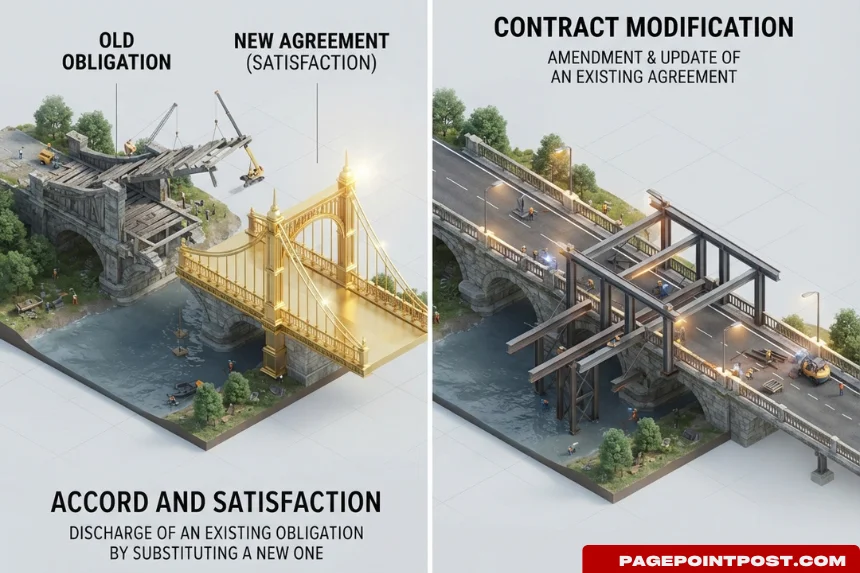
Accord and Satisfaction vs Contract Modification
Accord and satisfaction is not the same as contract modification.
A contract modification changes the original contract going forward. The parties continue the relationship under revised terms.
An accord and satisfaction usually settles or discharges an existing disputed obligation after substitute performance.
| Topic | Contract modification | Accord and satisfaction |
|---|---|---|
| Main purpose | Change contract terms | Settle a claim or obligation |
| Timing | Usually during ongoing contract | Often after dispute arises |
| Effect | Contract continues with new terms | Original claim may be discharged |
| Performance | Modified future performance | Substitute performance settles dispute |
| Common use | Price change, deadline change, scope change | Debt settlement, payment dispute, claim settlement |
For example, if a client and agency agree to add new services and raise the monthly fee, that is likely a modification. If the client disputes an old invoice and the agency accepts a reduced amount as full settlement, that may be accord and satisfaction.
Plain-language summary: Modification changes the contract; accord and satisfaction settles a disputed obligation.
Accord and Satisfaction vs Settlement Agreement
Accord and satisfaction and settlement agreements are closely related, but they are not always identical.
A settlement agreement is usually a written contract that resolves a dispute. It may include payment terms, releases, confidentiality, no-admission language, deadlines, and signatures.
Accord and satisfaction is a legal doctrine that may apply when parties agree to substitute performance and then complete it.
A settlement agreement can include accord and satisfaction language. For example, the agreement may state that payment of a certain amount will fully satisfy all claims between the parties.
| Topic | Settlement agreement | Accord and satisfaction |
|---|---|---|
| Form | Usually written and detailed | May be written or sometimes implied |
| Scope | Can cover many claims | Often tied to a specific obligation |
| Main function | Resolve dispute contractually | Discharge claim after substitute performance |
| Common clauses | Release, confidentiality, no admission | Full satisfaction, substitute performance |
Plain-language summary: A settlement agreement is a document; accord and satisfaction is the legal effect of settling through substitute performance.
Accord and Satisfaction vs Release
A release is an agreement where one party gives up a legal claim. A release may be broad or narrow.
Accord and satisfaction may discharge a claim because the parties agreed to substitute performance and completed it. A release may discharge a claim because the claimant expressly gives it up.
Often, both appear together. A settlement agreement may say:
- The debtor will pay a reduced amount.
- The creditor accepts that amount as full satisfaction.
- The creditor releases all related claims.
- Neither party admits liability.
This creates stronger documentation and reduces later disputes.
Plain-language summary: A release gives up claims, while accord and satisfaction settles claims through completed substitute performance.
Accord and Satisfaction vs Novation
A novation replaces an old contract or party with a new one. It usually requires clear intent to extinguish the old obligation and replace it with a new obligation.
Accord and satisfaction does not always immediately replace the original obligation. In many cases, the original claim is suspended until the new performance is completed. Once satisfaction occurs, the original claim is discharged.
| Topic | Novation | Accord and satisfaction |
|---|---|---|
| Main effect | Replaces old obligation | Settles old obligation after satisfaction |
| Common use | Substitute party or contract | Settle disputed debt or claim |
| Discharge timing | Often immediate if valid | Usually after satisfaction |
| Intent needed | Clear intent to replace | Clear intent to settle |
Plain-language summary: Novation replaces an obligation; accord and satisfaction settles an obligation through agreed substitute performance.
Common Examples of Accord and Satisfaction
1. Debt Settlement
A borrower owes $20,000 but disputes late fees and interest. The lender agrees to accept $15,000 as full settlement. The borrower pays $15,000. This may create accord and satisfaction.
2. Defective Work Dispute
A homeowner claims a contractor performed poor work. The contractor disputes the claim but accepts reduced payment to close the matter. The reduced payment may satisfy the claim if clearly accepted as settlement.
3. Business Invoice Dispute
A vendor sends a $12,000 invoice. The customer says part of the delivery was late and offers $9,000 as full payment. If the vendor knowingly accepts, accord and satisfaction may apply.
4. Insurance Claim Settlement
An insurer and policyholder disagree over claim value. The insurer offers a settlement amount. If the policyholder accepts and signs settlement terms, the claim may be resolved.
5. Lease Dispute
A tenant breaks a lease early. The landlord agrees to accept a lump-sum payment instead of suing for the full remaining rent. Once paid, the lease claim may be settled.
Plain-language summary: Accord and satisfaction often appears when parties compromise over disputed money, work quality, or contract duties.
“Paid in Full” Checks and Accord and Satisfaction
A “paid in full” check can create accord and satisfaction issues. This happens when a debtor sends a check for less than the claimed amount and clearly states that the check is offered as full satisfaction of the disputed claim.
For example, a customer owes a disputed invoice of $4,000 and sends a check for $2,500 marked “payment in full.” If the business deposits the check, the customer may argue that the business accepted the $2,500 as full settlement.
The result depends on jurisdiction, facts, and applicable law. Important questions may include:
- Was the claim genuinely disputed?
- Was the payment offered in good faith?
- Did the check or letter clearly say “full satisfaction”?
- Did the creditor know the condition?
- Did the creditor cash or deposit the payment?
- Did the creditor have a special payment-dispute address?
- Did the creditor return the money within the allowed time?
Businesses should create clear payment-handling policies. Employees should know not to casually deposit checks marked “paid in full” when the amount is disputed.
Plain-language summary: Cashing a “paid in full” check can be risky if the payment clearly tries to settle a disputed claim.
Requirements and Risks
Accord and satisfaction can be helpful, but it can also create problems.
Common risks include:
- Unclear settlement language
- No written agreement
- Dispute over whether payment was full settlement
- Accidental acceptance of reduced payment
- Cashing a “paid in full” check without review
- No proof of mutual agreement
- Failure to complete satisfaction
- Different state or country rules
- Confusion between partial payment and settlement
- Missing release language
- Tax or accounting consequences
- Dispute over authority to accept settlement
The safest approach is to document the agreement clearly. A good settlement should state what claim is being settled, what performance will occur, when it will happen, and whether the settlement is full and final.
Plain-language summary: Accord and satisfaction works best when the agreement is clear, written, and intentional.
How to Draft an Accord and Satisfaction Clause
A strong accord and satisfaction clause should be clear and specific. It should reduce confusion about what the parties are settling.
A clause may include:
- Names of the parties
- Description of the dispute
- Original amount or obligation
- Substitute payment or performance
- Deadline for performance
- Statement that performance is accepted as full satisfaction
- Release of related claims
- No admission of liability
- Confidentiality, if needed
- Consequences if payment is not made
- Signatures of authorized parties
Example wording:
“The parties agree that payment of $7,000 by Buyer to Seller on or before August 15, 2026, will constitute full and final satisfaction of all claims arising from Invoice #1048. Upon receipt and clearance of the payment, Seller releases Buyer from any further claim for the disputed balance. This agreement does not constitute an admission of liability by either party.”
This is only sample language. Real agreements should be reviewed for the specific facts and jurisdiction.
Plain-language summary: A good clause should clearly identify the dispute, the substitute performance, and the full settlement effect.
What Happens If Satisfaction Is Not Completed?
If the accord is made but the satisfaction is not completed, the original claim may remain enforceable. The non-breaching party may also have rights under the accord itself.
For example, suppose a creditor agrees to accept $6,000 by a certain date as full settlement of a disputed $10,000 claim. If the debtor never pays, the creditor may be able to pursue the original claim, depending on the terms and local law.
This is why settlement agreements should explain what happens if the substitute performance does not occur. The agreement may say the original debt returns, late fees apply, or the creditor may pursue all available remedies.
Plain-language summary: If the new performance is not completed, the original claim may still survive.
Common Mistakes to Avoid
Accord and satisfaction can fail or create disputes when parties handle it casually.
Avoid these mistakes:
- Accepting a reduced payment without clear terms
- Sending a “paid in full” check without legal advice
- Cashing a disputed check too quickly
- Failing to document the settlement
- Forgetting to include release language
- Confusing partial payment with full settlement
- Assuming every lower payment discharges the debt
- Ignoring state or country law
- Letting unauthorized employees accept settlement payments
- Using vague language such as “final payment” without context
- Failing to define the disputed claim
- Not confirming whether taxes or reporting issues apply
A clear written settlement is usually safer than relying on a note written on a check.
Plain-language summary: The biggest mistake is treating a disputed payment casually without clear settlement language.
Practical Tips for Businesses
Businesses can reduce accord and satisfaction risks by creating clear procedures.
Useful steps include:
- Train staff to flag “paid in full” checks
- Use a designated address for disputed payments where allowed
- Separate routine payments from settlement payments
- Require management approval for reduced settlements
- Document all settlement terms in writing
- Use clear invoice dispute procedures
- Keep copies of checks and communications
- Ask legal counsel before cashing conditional payments
- Include contract language about payment disputes
- Review local law before relying on accord and satisfaction
These steps help prevent accidental settlement and improve dispute handling.
Plain-language summary: Businesses should treat disputed payments carefully and document settlements clearly.
Quick Facts About Accord and Satisfaction
| Question | Short answer |
|---|---|
| What is accord? | The new settlement agreement |
| What is satisfaction? | Performance of that new agreement |
| What does it do? | May discharge the original claim |
| Common use | Debt and contract dispute settlement |
| Does it require a dispute? | Often yes, especially for reduced payment cases |
| Is partial payment always enough? | Usually no |
| Can a check create issues? | Yes, especially if marked “paid in full” |
| Is it the same as modification? | No |
| Is it the same as release? | No, but they often appear together |
| Should it be written? | Yes, written terms are safer |
Plain-language summary: Accord and satisfaction is a settlement tool, but clarity matters.
Sources and Further Reading
Use these sources to learn more about accord and satisfaction, contract settlement, and payment disputes:
- Cornell Legal Information Institute: Accord and Satisfaction
- Cornell Uniform Commercial Code § 3-311
- Investopedia: Accord and Satisfaction
- Practical Law: Novation, Accord and Satisfaction, and Substituted Contracts
- Legal contract drafting resources on settlement and release agreements
FAQs
What does accord and satisfaction mean?
Accord and satisfaction means settling a claim or obligation by agreeing to accept different performance and then completing that performance.
The accord is the agreement. The satisfaction is the completed payment, service, or other substitute performance.
What is an example of accord and satisfaction?
A contractor claims $10,000, but the customer disputes the quality of work. The contractor agrees to accept $7,000 as full settlement. The customer pays $7,000.
The agreement is the accord. The payment is the satisfaction.
What are the elements of accord and satisfaction?
Common elements include an existing claim, a dispute or uncertainty, a new agreement, substitute performance, acceptance, completion of performance, and intent to settle.
The exact requirements may vary by jurisdiction.
Is accord and satisfaction the same as settlement?
They are related but not exactly the same. A settlement agreement is usually a written contract that resolves a dispute. Accord and satisfaction is the legal doctrine that may discharge the original claim after substitute performance occurs.
A settlement agreement may include accord and satisfaction language.
What is the difference between accord and satisfaction and modification?
A modification changes the original contract. Accord and satisfaction settles an existing disputed obligation by accepting different performance.
Modification usually affects future duties, while accord and satisfaction often resolves a past or current dispute.
Can cashing a “paid in full” check create accord and satisfaction?
Yes, in some situations. If a claim is disputed and a debtor sends a check clearly marked as full settlement, cashing the check may support an accord and satisfaction argument.
The result depends on the law, facts, and communications between the parties.
Does accord and satisfaction require writing?
Not always, but a written agreement is much safer. Written terms help prove the parties intended to settle the claim.
Without writing, the parties may later disagree about what they agreed to.
What happens if satisfaction is not completed?
If the substitute performance is not completed, the original claim may remain enforceable. The other party may also have rights under the accord, depending on the agreement and local law.
Settlement terms should explain what happens if performance fails.
Is partial payment enough for accord and satisfaction?
Partial payment is not always enough. If the debt is fixed and undisputed, paying less than the full amount may not discharge the rest.
Accord and satisfaction is stronger when there is a genuine dispute and clear agreement to accept the substitute performance as full settlement.
Why is accord and satisfaction important?
It helps parties settle disputes without litigation. It can save time, reduce legal costs, and provide certainty.
However, it must be handled carefully because unclear settlement terms can create new disputes.
Conclusion
Accord and satisfaction is a legal way to settle a disputed claim or obligation through substitute performance. The accord is the new agreement, and the satisfaction is the completion of that agreement. Once satisfaction occurs, the original claim may be discharged.
The doctrine often appears in debt settlements, contract disputes, invoice disagreements, construction conflicts, insurance claims, and “paid in full” check situations. It can be useful, but it requires clear intent and careful documentation.
The safest approach is to put the settlement in writing, describe the dispute, state the substitute performance, confirm that it is accepted as full and final satisfaction, and include release language when needed. Because rules vary by jurisdiction, parties should get legal advice before relying on accord and satisfaction in an important dispute.
Discover more on our website about charles barkley net worth