


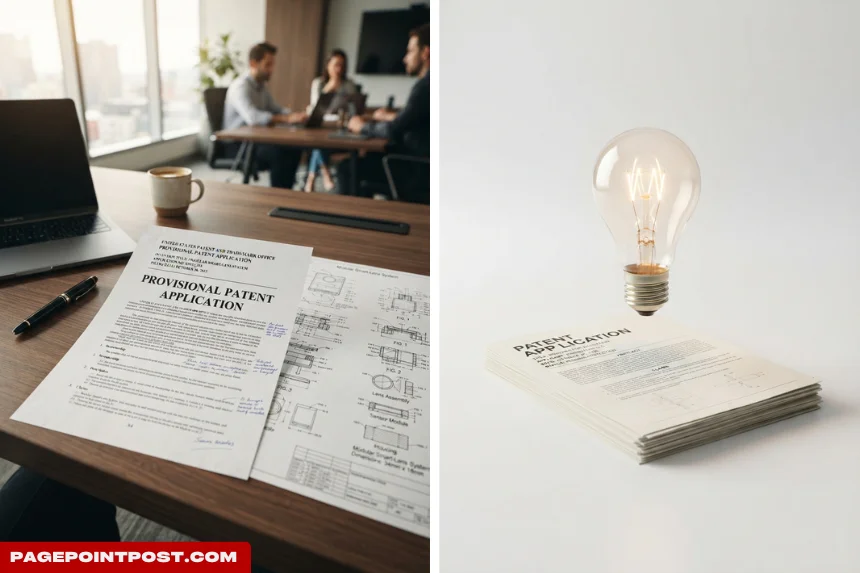
A provisional patent application is an early patent filing that lets an inventor establish a filing date for an invention before filing a full non-provisional patent application. It is often used by inventors, startups, product developers, engineers, researchers, and businesses that want time to test an idea, speak with investors, improve a prototype, or prepare a stronger patent strategy.
A provisional patent application does not become a patent by itself. It is not examined for patentability, and it does not give enforceable patent rights on its own. Instead, it creates a temporary 12-month window. During that window, the applicant can use “patent pending” and decide whether to file a corresponding non-provisional patent application.
The biggest benefit of a provisional patent application is the early filing date. The biggest risk is filing something too vague, incomplete, or rushed. A weak provisional application may not support the claims later filed in the non-provisional application.
Legal note: This article is general information only. It is not legal advice. Patent rules are technical, deadlines are strict, and international filing decisions can be complex. Inventors should speak with a qualified patent attorney or registered patent agent before relying on a provisional patent application.
What Is a Provisional Patent Application?
A provisional patent application is a temporary patent application filed before a non-provisional patent application. It helps establish an early filing date for an invention.
In simple terms, it is a placeholder filing. It tells the patent office that the inventor had possession of the invention on a specific date. If a later non-provisional application properly claims priority to the provisional application, that later application may benefit from the earlier filing date for the subject matter that was fully disclosed.
A provisional patent application is commonly used for utility inventions and plant inventions. It is not used for design patents in the United States.
A provisional application usually includes a written description of the invention, drawings if needed, inventor information, a cover sheet, and a filing fee. It does not require formal patent claims in the same way a non-provisional utility application does, but the disclosure still needs to be strong enough to support later claims.
Plain-language summary: A provisional patent application is a temporary filing that can secure an early filing date, but it does not become a patent on its own.

Quick Answer
A provisional patent application gives an inventor a 12-month period to develop a full patent strategy. During that time, the inventor may use the phrase “patent pending” for the invention described in the application.
Key points:
- It helps establish an early filing date.
- It lasts for 12 months.
- It is not examined by the patent office.
- It does not issue as a patent.
- It has fewer formal filing requirements than a non-provisional application.
- It must be followed by a corresponding non-provisional application to pursue patent protection.
- The later non-provisional application must be supported by the provisional disclosure.
- New material added later may not receive the provisional filing date.
- Missing the deadline can cause loss of priority benefits.
A provisional patent application can be valuable, but only when it is drafted carefully. It should describe the invention clearly, completely, and with enough detail to support future patent claims.
Plain-language summary: A provisional patent application gives you a temporary filing date and patent-pending status, but you still need a later non-provisional application.
How a Provisional Patent Application Works
A provisional patent application works by creating an early filing date for the invention described in the application. After filing, the applicant has 12 months to file a corresponding non-provisional patent application.
The basic process looks like this:
| Step | What happens |
|---|---|
| 1. Prepare the invention disclosure | Describe how the invention works, how to make it, and how to use it |
| 2. Add drawings if needed | Include diagrams, flowcharts, screenshots, prototypes, or technical drawings |
| 3. File the provisional application | Submit the application with required information and fee |
| 4. Receive a filing date | The filing date becomes the provisional priority date |
| 5. Use the 12-month window | Test, improve, pitch, raise funding, or assess commercial value |
| 6. File a non-provisional application | File before the deadline and claim priority to the provisional |
| 7. Patent examination begins later | The non-provisional application is examined, not the provisional |
The provisional filing date matters only for what the provisional application actually supports. If the non-provisional application later includes new features that were not described in the provisional, those new features may not get the earlier date.
Plain-language summary: File the provisional first, then file a full non-provisional within 12 months if you want to continue toward a patent.
What Must Be Included in a Provisional Patent Application?
A provisional patent application is simpler than a non-provisional application, but it still needs enough detail to be useful.
A strong provisional application usually includes:
- Title of the invention
- Names of all inventors
- Written description of the invention
- Explanation of the problem being solved
- Summary of how the invention works
- Drawings or diagrams if needed
- Description of different versions or embodiments
- Steps, components, methods, materials, or systems
- Best known way to make and use the invention
- Filing fee
- Cover sheet or application data information
The written description is the most important part. It should explain the invention clearly enough that someone skilled in the relevant field could understand it and practice it.
For many inventions, drawings are critical. Drawings may include:
- Product diagrams
- Mechanical drawings
- Electrical diagrams
- Software flowcharts
- Screenshots
- Process steps
- System architecture
- Exploded views
- Chemical structures
- Prototype images
- Block diagrams
Even if formal claims are not required, some applicants include claim-like language or a section describing the inventive features. This can help guide the later non-provisional application.
Plain-language summary: A provisional application should describe the invention in real detail, not just state the idea.
What a Provisional Patent Application Does Not Do
A provisional patent application has limits. Many inventors misunderstand what it provides.
A provisional patent application does not:
- Grant a patent
- Get examined for patentability
- Give the right to sue for infringement by itself
- Last longer than 12 months
- Automatically turn into a non-provisional application
- Protect vague ideas without enough disclosure
- Cover new material added after filing
- Replace a patentability search
- Guarantee that a patent will be granted
- Protect design inventions in the United States
- Solve international filing issues automatically
The phrase “patent pending” can be useful, but it does not mean the invention has been approved. It only means that a patent application has been filed.
Plain-language summary: A provisional application is not a patent. It is a temporary filing that may support a later patent application.
Benefits of Filing a Provisional Patent Application
A provisional patent application can be useful for many inventors and businesses.
1. Early Filing Date
The main benefit is the early filing date. In a first-inventor-to-file system, filing early can be important.
2. Patent Pending Status
After filing, the applicant can usually mark the invention as “patent pending.” This can help with marketing, investor conversations, licensing discussions, and competitor deterrence.
3. More Time to Prepare
The 12-month period gives the inventor time to improve the invention, prepare a stronger non-provisional application, test the market, or seek funding.
4. Lower Initial Formality
A provisional application has fewer formal requirements than a full non-provisional application. This can make it a practical first step.
5. Useful for Startups
Startups often use provisional applications before investor pitches, product launches, accelerator programs, demos, or partnership discussions.
6. Time to Test Commercial Value
An inventor can use the 12 months to ask whether the invention is worth the cost of full patent prosecution.
7. Time to Improve the Invention
The inventor may discover improvements during testing. Those improvements may require additional filings, but the provisional window can support product development.
8. Strategic Flexibility
A provisional application can help the applicant decide whether to file in the United States, internationally, or not at all.
Plain-language summary: A provisional patent application can buy time, establish a filing date, and support patent-pending status.
Risks and Common Mistakes
A provisional patent application can be risky if treated as a quick form instead of a serious legal document.
Common mistakes include:
- Filing a vague idea
- Leaving out important technical details
- Not explaining how to make and use the invention
- Missing drawings
- Naming the wrong inventors
- Waiting too long to file the non-provisional application
- Forgetting the 12-month deadline
- Publicly disclosing the invention before filing
- Assuming the provisional becomes a patent automatically
- Adding major new features later and assuming they get the old date
- Filing without a patentability search
- Using marketing language instead of technical disclosure
- Not planning for international rights
- Not getting professional help when the invention is valuable
The biggest danger is weak disclosure. If the provisional application does not describe the invention well enough, the later non-provisional claims may not receive the provisional filing date.
For example, if an inventor files a short provisional that only says “a smart bottle that tracks hydration,” that may not be enough. A stronger application would explain the sensors, data processing, user interface, power source, communication method, bottle structure, calibration, and alternative designs.
Plain-language summary: A rushed provisional can give false confidence and fail to protect the invention later.
Provisional vs Non-Provisional Patent Application
A provisional patent application and a non-provisional patent application serve different purposes.
| Feature | Provisional application | Non-provisional application |
|---|---|---|
| Main purpose | Establish early filing date | Seek examination and patent grant |
| Examined by patent office? | No | Yes |
| Can issue as a patent directly? | No | Yes |
| Formal claims required? | No | Yes |
| Oath/declaration required? | No | Yes |
| Duration | 12 months | Continues through examination |
| Patent pending? | Yes, after filing | Yes, after filing |
| Best use | Early strategy and priority | Actual patent prosecution |
| Risk | Weak disclosure may not support later claims | Higher cost and formal requirements |
| Design patents? | Not available for U.S. design inventions | Available through design application process |
A provisional application is often the first step. The non-provisional application is the formal application that can be examined and potentially granted as a patent.
Plain-language summary: A provisional application starts the clock; a non-provisional application starts the real examination process.
When Should You File a Provisional Patent Application?
A provisional patent application may be useful when the invention is developed enough to describe clearly but the inventor is not ready to file a full non-provisional application.
Common timing situations include:
- Before showing the invention to investors
- Before pitching to companies
- Before launching a product
- Before publishing a paper
- Before presenting at a trade show
- Before starting a crowdfunding campaign
- Before sharing with manufacturers
- Before entering accelerator programs
- Before testing with outside users
- Before licensing discussions
However, filing too early can be a problem. If the invention changes significantly after filing, the original provisional may not cover the improved version. In some cases, inventors file additional provisional applications as improvements are developed.
The best time to file is usually when the invention is concrete enough to describe in detail and before any public disclosure that could harm patent rights.
Plain-language summary: File before public disclosure, but make sure the invention is developed enough to describe clearly.
Public Disclosure and the 12-Month Deadline
Public disclosure can create serious patent issues. disclosure may include selling the invention, publishing details, using it publicly, posting online, presenting at a conference, launching a product, or offering it for sale.
In the United States, there may be a limited grace period for certain inventor disclosures. However, many foreign countries are stricter. A public disclosure before filing can destroy foreign patent rights.
The provisional application also has its own 12-month deadline. If the applicant does not file a corresponding non-provisional application in time, the provisional application is abandoned and the applicant may lose the benefit of the early filing date.
This is why inventors should create a deadline calendar immediately after filing.
Important dates to track:
- Date of first public disclosure
- Provisional filing date
- 12-month non-provisional deadline
- International filing deadline
- Investor pitch dates
- Product launch dates
- Trade show dates
- Publication dates
Plain-language summary: Public disclosure and missed deadlines can damage patent rights, so timing matters.
Does a Provisional Patent Application Protect Your Invention?
A provisional patent application can help protect an invention, but not in the same way an issued patent does.
It can help by:
- Establishing an early filing date
- Supporting a later non-provisional application
- Allowing patent-pending notice
- Creating a record of the invention
- Supporting investor and licensing discussions
- Deterring some competitors
It does not help by:
- Giving immediate enforceable patent rights
- Letting you sue for infringement based only on the provisional
- Guaranteeing that claims will be allowed
- Protecting subject matter not disclosed
- Replacing a full patent application
Real patent rights come only if a patent is eventually granted. The provisional application is part of the path toward that result.
Plain-language summary: A provisional application can support protection, but it is not the same as owning a granted patent.
Cost and Filing Considerations
The cost of a provisional patent application depends on how it is prepared. Government filing fees vary by applicant status and may change over time. Professional drafting fees also vary depending on complexity.
Cost factors include:
- Type of invention
- Technical complexity
- Number of drawings
- Amount of detail needed
- Attorney or agent involvement
- Prior art search
- Number of inventors
- Startup or business strategy
- International filing plans
A simple invention may cost less to prepare than a complex software, biotech, electronics, medical device, or mechanical system. However, the cheapest filing is not always the best filing. If the disclosure is weak, the application may not provide meaningful priority support.
Some inventors file provisionals themselves. This is possible, but it can be risky when the invention has significant commercial value.
Plain-language summary: A low-cost provisional may save money upfront, but a poorly drafted one can cost more later.

Can You File a Provisional Patent Application Yourself?
Yes, inventors can file a provisional patent application themselves. However, self-filing requires care.
A DIY provisional should not be just a short product description. It should explain the invention in enough detail to support future claims.
A stronger DIY draft may include:
- Background problem
- Summary of the solution
- Detailed description
- Drawings and labels
- Alternative versions
- Materials or components
- Step-by-step operation
- Software logic or flowcharts
- Use cases
- Advantages
- Variations
- Possible claim concepts
Professional help is often worth considering when the invention may become valuable, when investors are involved, when competitors are active, or when international protection is possible.
Plain-language summary: You can file yourself, but professional drafting is safer for important inventions.
Provisional Patent Application for Startups
Startups often use provisional patent applications because they need flexibility. A startup may not have the money for a full patent strategy at the beginning, but it may need to protect its idea before fundraising or public launch.
A provisional application can help a startup:
- Speak with investors more confidently
- Use patent-pending language
- Create an IP asset for due diligence
- Protect early technical work
- Buy time before a larger filing
- Support licensing conversations
- Delay some patent costs
- Coordinate product and patent strategy
However, investors may look closely at the quality of the filing. A thin provisional may not impress sophisticated investors. A stronger filing shows that the company took intellectual property seriously.
Plain-language summary: Startups use provisional applications to move quickly, but quality still matters.
Provisional Patent Application for Software
Software inventions can be difficult because patent eligibility and technical disclosure requirements can be complex. A software provisional should describe more than the business idea.
It may need to explain:
- System architecture
- Data flows
- User interfaces
- Algorithms
- Processing steps
- Technical problem
- Technical improvement
- Hardware or network environment
- Databases
- Machine learning models, if relevant
- Security features
- Alternative implementations
A vague statement like “an app that matches users with service providers” may not be enough. The application should explain how the system works technically and what makes it different.
Plain-language summary: A software provisional should describe technical implementation, not just a business concept.
Provisional Patent Application for Products
For physical products, the provisional application should describe the structure and function of the invention.
Useful details may include:
- Parts and components
- Materials
- Dimensions or ranges
- How parts connect
- Manufacturing methods
- Assembly process
- Use instructions
- Alternative shapes
- Safety features
- Drawings from multiple angles
- Prototype photos
- Exploded diagrams
- Variations and improvements
For example, if the invention is a new kitchen tool, the application should explain the handle, blade, hinge, materials, grip, motion, cleaning method, and alternative designs.
Plain-language summary: A product provisional should show what the invention is, how it is built, and how it works.
Provisional Patent Application Timeline
The basic timeline is simple, but the decisions can be complex.
| Time | Action |
|---|---|
| Before filing | Develop invention and prepare disclosure |
| Filing date | Submit provisional application |
| After filing | Use patent-pending notice |
| Months 1–3 | Improve prototype and conduct market testing |
| Months 3–6 | Speak with investors, customers, or partners |
| Months 6–9 | Conduct patent search and refine strategy |
| Months 9–11 | Prepare non-provisional application |
| Before 12 months | File non-provisional application or international application strategy |
| After deadline | Provisional is abandoned if not followed properly |
Inventors should not wait until the final week. A strong non-provisional application can take time to prepare.
Plain-language summary: The provisional gives 12 months, but the non-provisional should be planned well before the deadline.
International Patent Strategy
A provisional patent application can affect international filing strategy. In many cases, the first patent filing starts a priority clock for later filings in other countries.
Inventors who want protection outside the United States should think carefully before filing or publicly disclosing the invention. Foreign patent rights can be lost if the invention is publicly disclosed before filing.
International strategy may involve:
- Filing in individual countries
- Filing a PCT application
- Deciding which markets matter
- Considering manufacturing countries
- Considering competitor locations
- Budgeting for translations and local counsel
- Managing the 12-month priority period
International patent protection is expensive and technical. A provisional application can be the first step, but it is not a complete global patent strategy.
Plain-language summary: If foreign patents matter, plan internationally before public disclosure and before the 12-month deadline.
What Happens After 12 Months?
After 12 months, the provisional application is automatically abandoned if the applicant does not take proper action. It does not become a patent. It does not continue pending indefinitely.
Before the deadline, the applicant usually needs to file:
- A corresponding non-provisional patent application, or
- An international/PCT application strategy, where appropriate, or
- Another legally appropriate filing path based on advice
If the applicant misses the deadline, the early filing date may be lost. In some limited circumstances, restoration may be possible, but inventors should never rely on that as a plan.
Plain-language summary: Before 12 months expire, you must take the next step or the provisional filing loses its main value.
How to Strengthen a Provisional Patent Application
A strong provisional application should be written like the foundation for a future patent, not like a product brochure.
Ways to strengthen it include:
- Describe the invention in detail
- Include multiple examples
- Add clear drawings
- Explain alternatives
- Identify key features
- Describe how to make and use it
- Include technical advantages
- Avoid vague marketing claims
- Include variations and embodiments
- Make sure all inventors are named
- Consider a prior art search
- Align the filing with business goals
- Work with a patent professional when value is high
The best provisional applications are broad enough to support future claims but detailed enough to prove possession of the invention.
Plain-language summary: The stronger the disclosure, the more useful the provisional filing may be later.
Common Mistakes to Avoid
Avoid these common mistakes:
- Thinking a provisional is a patent
- Filing only a one-page summary
- Leaving out drawings
- Missing the 12-month deadline
- Publicly disclosing before filing
- Forgetting foreign patent rights
- Not naming all inventors
- Adding new matter later and assuming it is protected
- Waiting too long to prepare the non-provisional
- Using only marketing language
- Not explaining technical details
- Filing before the invention is developed enough
- Filing and then doing nothing for 12 months
- Ignoring competitor patents
- Assuming patent pending means approval
Plain-language summary: The biggest mistakes are weak disclosure, missed deadlines, and misunderstanding what patent pending means.
Quick Facts About Provisional Patent Applications
| Question | Short answer |
|---|---|
| What is it? | A temporary patent filing |
| Does it become a patent? | No |
| Is it examined? | No |
| How long does it last? | 12 months |
| Can you say patent pending? | Yes, after filing |
| Are formal claims required? | No |
| Are drawings required? | Needed when necessary to understand the invention |
| Does it protect new later improvements? | Not unless those improvements are filed |
| What comes next? | A non-provisional patent application |
| Main benefit | Early filing date |
| Main risk | Weak disclosure or missed deadline |
| Best use | Buying time while preserving priority strategy |
Plain-language summary: A provisional application is a temporary filing tool, not a finished patent.
Sources and Further Reading
Use these sources to learn more about provisional patent applications and patent filing strategy:
- USPTO: Provisional Application for Patent
- USPTO: Applying for Patents
- USPTO: Nonprovisional Utility Patent Application Filing Guide
- USPTO: Drafting a Provisional Application
- WIPO: Paris Convention priority rules
- WIPO: PCT filing information
- Patent attorney or registered patent agent resources
FAQs
What is a provisional patent application?
A provisional patent application is a temporary patent filing that helps establish an early filing date for an invention. It gives the applicant up to 12 months to file a corresponding non-provisional patent application.
It does not become a patent by itself.
How long does a provisional patent application last?
A provisional patent application lasts 12 months from its filing date. After that, it is automatically abandoned unless the applicant has taken the proper next step.
The usual next step is filing a corresponding non-provisional application before the deadline.
Does a provisional patent application protect my invention?
It can help protect your invention by establishing an early filing date and supporting a later patent application. However, it does not give enforceable patent rights by itself.
Only an issued patent gives enforceable patent rights.
Can I say “patent pending” after filing a provisional patent application?
Yes, an applicant can generally use “patent pending” after filing a provisional patent application for the invention described in the application.
However, patent pending does not mean the patent has been approved.
What happens after 12 months?
After 12 months, the provisional application is abandoned. To keep the benefit of the filing date, the applicant must usually file a corresponding non-provisional patent application before the deadline.
Missing the deadline can cause loss of priority benefits.
What is the difference between provisional and non-provisional patent application?
A provisional application is a temporary filing that is not examined and cannot issue as a patent. A non-provisional application is the formal application examined by the patent office and may issue as a patent if requirements are met.
The provisional is often the first step. The non-provisional is the application that moves toward patent grant.
Can I file a provisional patent application myself?
Yes, inventors can file a provisional application themselves. However, the application must still describe the invention clearly and completely enough to support later claims.
For valuable inventions, professional help is often recommended.
Is a provisional patent application worth it?
A provisional patent application can be worth it when the inventor needs an early filing date, patent-pending status, time to test the market, or time to prepare a full patent application.
It may not be worth much if it is vague, incomplete, or never followed by a non-provisional application.
Do I need drawings for a provisional patent application?
Drawings should be included when they are needed to understand the invention. For many inventions, drawings are extremely important.
A missing drawing can weaken the disclosure and make it harder to support later claims.
Can I add new material to a provisional patent application later?
Generally, new matter added later does not get the original filing date. If the invention improves after filing, the inventor may need another provisional application or a carefully planned non-provisional filing.
This is one reason patent strategy should be planned early.
Conclusion
A provisional patent application is a useful tool for inventors and businesses that need an early filing date and time to decide whether to pursue full patent protection. It can support patent-pending status, help with fundraising, and give the inventor up to 12 months to prepare the next filing.
However, a provisional patent application is not a patent. It is not examined, does not issue by itself, and does not create enforceable patent rights. Its value depends on the quality of the disclosure and whether the applicant files a proper non-provisional application before the deadline.
The best provisional applications are detailed, technical, complete, and aligned with a clear business and patent strategy. When the invention has commercial value, professional patent guidance can help avoid weak disclosure, missed deadlines, and lost rights.
Discover more on our website about accord and satisfaction