


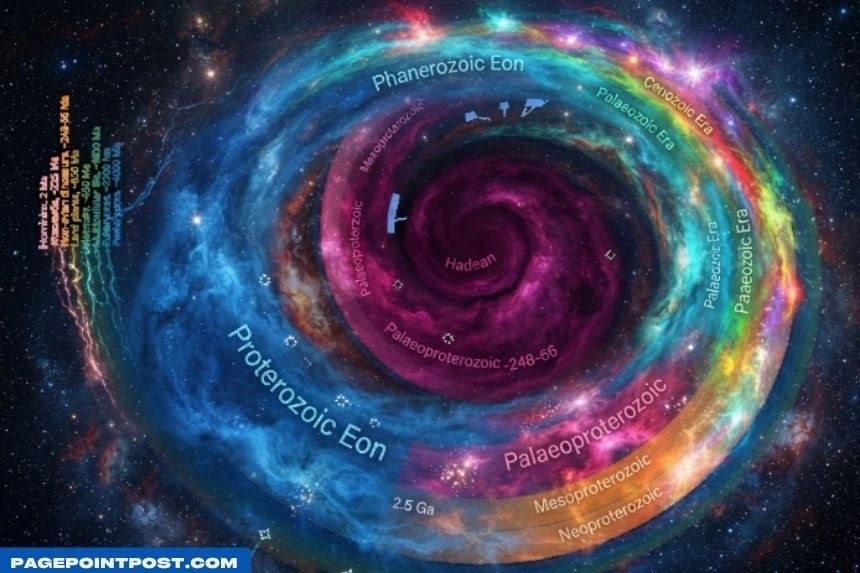
How long is an eon? A simple answer is one billion years. That
meaning appears in astronomy and some dictionaries. However, geology
uses “eon” differently. A geologic eon is the largest major division of
Earth’s history, and its duration is not fixed at exactly one billion
years.
Therefore, both answers can be correct in the right context. If someone
uses “eon” as a numerical unit, think one billion years. If a geologist
names an eon, look at its actual boundaries instead.
How Long Is an Eon in Years?
An eon can equal 1,000,000,000 years, or one billion years, in a
numerical sense.
Merriam-Webster
includes this billion-year meaning while also defining an eon as a very
large division of geologic time.
However, named geologic eons have unequal lengths. Scientists divide
Earth history according to internationally recognized boundaries, not
into identical billion-year blocks. Consequently, saying “every eon
lasts one billion years” would be misleading.
Meaning of “eon” Typical length Best context
Numerical use 1 billion years Astronomy and general
scientific shorthand
Geologic eon Varies Earth history and
stratigraphy
So, context determines the best answer. For a quick conversion question,
one billion years often works. For geology, the named interval matters
more than a fixed number.
Why a Geologic Eon Does Not Have One Fixed Length
Geologists use an eon as a rank, not as a stopwatch unit. In other
words, “eon” tells you where an interval sits within the geologic
hierarchy. It does not require every interval at that rank to contain
the same number of years.
The International Commission on
Stratigraphy maintains the
International Chronostratigraphic Chart. This chart organizes Earth
history and records internationally accepted boundaries. Moreover, the
ICS notes that numerical ages can receive revisions as scientific
evidence improves.
As a result, geologic eons vary considerably. The Proterozoic lasted far
longer than the current Phanerozoic has lasted so far. Likewise, the
Archean covers well over a billion years.
This distinction solves most confusion. A billion-year definition
describes one use of the word. Meanwhile, the geologic definition
describes a category of time intervals.
Where an Eon Fits on the Geologic Time Scale
The geologic time scale works like a nested filing system. Scientists
divide enormous stretches of Earth history into progressively smaller
units. Therefore, an eon sits near the top of that system.
The usual hierarchy runs:
Eon → Era → Period → Epoch → Age
For example, we live in the Phanerozoic Eon. Within it sits the Cenozoic
Era. The Cenozoic contains the Quaternary Period, which includes the
Holocene Epoch.
The U.S. Geological
Survey explains
geologic time as the span from Earth’s formation to the present.
Similarly, the National Park Service geologic time
scale shows how
eons, eras, periods, and epochs organize that vast history.
Thus, an eon is much larger than an era. An era, in turn, contains
periods. This hierarchy helps scientists communicate when rocks formed,
organisms lived, and major planetary changes occurred.
The Four Eons of Earth History
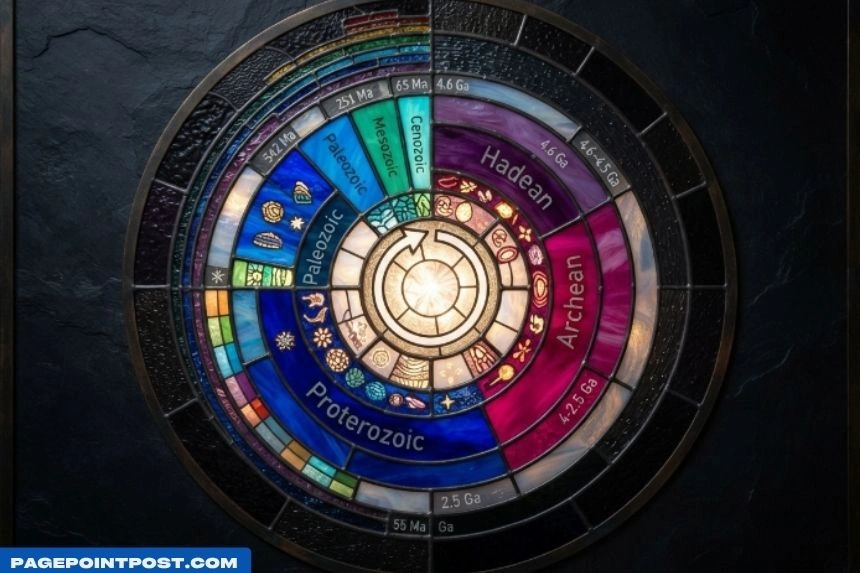
Earth’s history is commonly divided into four eons: Hadean, Archean,
Proterozoic, and Phanerozoic. Together, they cover roughly 4.6 billion
years of planetary history.
The National Park
Service
provides a reader-friendly overview of deep time. Meanwhile, the USGS
divisions of geologic
time
provides formal terminology and numerical conventions.
Eon Approximate span Approximate duration
Hadean Earth’s formation to About 0.5–0.6 billion years
about 4.0 billion
years ago
Archean About 4.0 to 2.5 About 1.5 billion years
billion years ago
Proterozoic 2.5 billion to about Nearly 2 billion years
539 million years ago
These rounded figures make the scale easier to understand. However,
readers who need current formal boundaries should consult the latest ICS
chart.
Hadean: Earth’s Earliest Chapter
The Hadean begins with the formation of Earth. During this remote
interval, the young planet underwent enormous physical and chemical
change.
Because extremely ancient rocks are scarce, scientists reconstruct much
of this interval from surviving minerals and other evidence. Therefore,
the Hadean differs from later eons with richer rock records.
Its duration also demonstrates the main point. A named eon does not need
to last one billion years.
Archean: An Eon Longer Than a Billion Years
The Archean followed the Hadean and extended to about 2.5 billion years
ago. Consequently, it lasted roughly 1.5 billion years under rounded
boundary values.
Ancient crust and evidence of early life make this interval especially
important. Moreover, its length clearly exceeds the simple “one eon
equals one billion years” shortcut.
Therefore, geology students should treat the billion-year figure
carefully. It helps with one definition, but it does not replace the
formal time scale.
Proterozoic: Nearly Two Billion Years
The Proterozoic stretches from about 2.5 billion years ago to the
beginning of the Phanerozoic. As a result, it spans close to two billion
years.
Major changes in Earth’s atmosphere, oceans, and life occurred across
this immense interval. Yet those events did not happen within one
uniform billion-year box.
Instead, scientists subdivide the Proterozoic into smaller eras and
periods. This layered system makes an otherwise overwhelming span easier
to study.
Phanerozoic: The Eon We Live In
The Phanerozoic began roughly 539 million years ago and continues today.
Therefore, its elapsed duration remains far below one billion years.
This eon contains the Paleozoic, Mesozoic, and Cenozoic eras. Dinosaurs
appeared during the Mesozoic, while humans arrived extremely late in the
Cenozoic.
For additional context, the Wikipedia geologic time
scale summarizes the
hierarchy and links the major divisions together. Wikipedia is useful
for orientation; however, the ICS remains the stronger source for
current formal boundaries.
What Does One Billion Years Actually Feel Like?
One billion years is difficult to imagine because human experience
operates on much smaller scales. Still, simple conversions can make the
number more concrete.
One billion years equals approximately:
- 1,000 million years
- 10 million centuries
- 100 million decades
- about 365.24 billion days, using an average year length
However, those numbers still feel abstract. A scale model works better.
Imagine compressing one billion years into one calendar year. In that
model, each day would represent roughly 2.74 million years.
Likewise, one hour would represent about 114,000 years. One minute would
cover roughly 1,900 years. Human recorded history would occupy only a
tiny fraction near the end.
Therefore, “one billion years” is not merely a very long historical
period. It reaches far beyond civilizations, agriculture, and even the
existence of our species.
Eon vs Era: Which One Is Longer?
An eon is larger than an era in the standard geologic hierarchy.
Specifically, eons contain eras, while eras contain periods.
For instance, the Phanerozoic Eon contains three familiar eras:
Paleozoic, Mesozoic, and Cenozoic. Therefore, calling the Mesozoic an
eon would place it at the wrong rank.
This difference matters because casual writing often treats “eon,”
“era,” and “age” as interchangeable words. In geology, however, they
have distinct roles.
A simple memory rule helps:
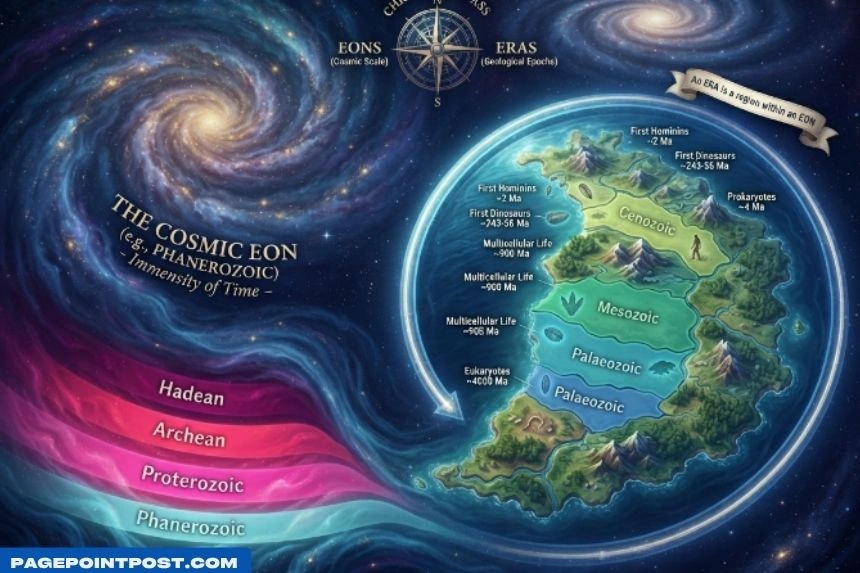
Eon is the biggest standard time division; eras live inside eons.
Nevertheless, exact durations still vary. Rank describes position in the
hierarchy, not a mandatory number of years.
Eon vs Epoch, Period, Age, and Millennium
Several time words sound similar, yet they operate at very different
scales. A millennium always equals 1,000 years. Geological ranks, by
contrast, usually depend on defined boundaries.
Term What it means
Eon Largest major geochronologic rank
Era Major subdivision of an eon
Period Subdivision of an era
Epoch Subdivision of a period
Age Smaller formal geochronologic rank
Millennium Exactly 1,000 years
Therefore, “millennium” behaves like a fixed measurement. “Eon” in
formal geology behaves like a named rank.
This distinction also explains why multiplying a geologic eon by a fixed
conversion factor can fail. First identify whether the writer means a
billion-year unit, a named geologic interval, or simply “a very long
time.”
How Scientists Decide Where Eons Begin and End
Scientists do not divide deep time merely because a round number looks
convenient. Instead, stratigraphers study rock sequences, fossils,
geochemical signals, and other globally useful evidence.
The ICS coordinates international work on these divisions. For many
younger boundaries, scientists use formally ratified reference points in
rock sections. Meanwhile, some very old Precambrian boundaries have
historically relied on numerical ages.
As evidence improves, numerical estimates can change. Therefore,
reputable charts sometimes show slightly different dates, especially
when comparing older educational resources with current standards.
That does not mean geologic time is arbitrary. Rather, science refines
measurements while maintaining a shared framework. The hierarchy remains
useful because researchers can connect rocks and events across
continents.
Consequently, readers should check the publication date when exact
boundary ages matter. For ordinary questions about how long an eon is,
rounded values usually communicate the scale more clearly.
Why “An Eon Is a Billion Years” Can Still Be Useful
The one-billion-year answer survives because it gives people an
immediate scale. Moreover, astronomy often needs convenient language for
extremely long durations.
If a text explicitly defines an eon as one billion years, the conversion
is straightforward. Two eons equal two billion years, while half an eon
equals 500 million years.
However, that arithmetic should not be applied automatically to named
geological eons. The Archean, Proterozoic, and Phanerozoic have their
own boundaries and durations.
So, use this practical rule: numerical eon = often one billion years;
named geologic eon = check its boundaries.
That single distinction answers the keyword accurately without
oversimplifying Earth science.

Everyday Meaning of “Eon”
Outside science, “eon” usually means an extremely long or seemingly
endless time. Someone might say, “I haven’t seen that friend in eons.”
Obviously, the speaker does not mean a literal billion years.
Therefore, everyday usage works as exaggeration. Dictionaries recognize
this broad meaning alongside scientific senses.
The spelling aeon also appears, especially in British usage. Both
forms can refer to a vast or indefinite stretch of time.
Context again provides the clue. If the sentence discusses planets,
geology, or scientific scales, a technical meaning may apply. However,
if someone complains that a queue took “eons,” the word simply
emphasizes how long the wait felt.
Common Mistakes About the Length of an Eon
The most common mistake is treating every eon as exactly one billion
years. That rule works only for the specific billion-year sense.
Another mistake is assuming every large geologic division has equal
length. In fact, eons, eras, periods, and epochs vary because scientists
define them around the structure and evidence of Earth history.
People also confuse “eon” with “era.” However, an era is one level below
an eon.
Finally, some readers treat older educational charts as permanently
exact. Geological science keeps refining boundary ages. Therefore, use
the current ICS chart when precision matters.
These corrections make the concept much easier. First identify the
context. Then decide whether “eon” means a numerical billion years, a
formal geologic division, or an informal very long time.
A Simple Way to Remember How Long an Eon Is
Remember two ideas instead of one rigid definition.
First, one eon can mean one billion years in numerical or
astronomical usage. Second, a geologic eon has no single fixed
duration because named eons follow defined boundaries.
Then remember the hierarchy: eon, era, period, epoch, age.
This approach prevents the most common errors. Moreover, it gives you a
fast answer for general questions without sacrificing scientific
accuracy.
If a quiz asks for a simple numerical conversion, one billion years may
be the expected answer. However, if the question asks about the Archean
or Phanerozoic, use the actual span of that named eon.
Frequently Asked Questions About Eons
1. How long is an eon exactly?
An eon can mean exactly one billion years in a numerical sense. However,
a named geologic eon does not have one fixed length. Its duration
depends on its formally recognized boundaries.
2. Is an eon always one billion years?
No. Although some scientific and dictionary definitions use one billion
years, geologic eons vary. Therefore, the context determines whether the
billion-year conversion applies.
3. How many years are in two eons?
If “eon” means the numerical unit of one billion years, two eons equal
two billion years. However, two named geological eons could cover a
different combined duration.
4. Is an eon longer than an era?
Yes. In the geologic hierarchy, an eon contains eras. Therefore, an eon
ranks above an era, although the exact duration of each named interval
varies.
5. What eon are we living in now?
We live in the Phanerozoic Eon. More specifically, we live within the
Cenozoic Era, which forms the youngest era of the Phanerozoic.
6. How many eons are in Earth’s history?
Scientists commonly recognize four major eons of Earth history: Hadean,
Archean, Proterozoic, and Phanerozoic. Together, they span Earth’s
roughly 4.6-billion-year history.
7. What is the longest geologic eon?
Using current conventional boundaries, the Proterozoic is the longest of
the four major eons. It lasted close to two billion years, from about
2.5 billion to roughly 539 million years ago.
8. Is an eon longer than a millennium?
Yes, by an enormous margin. A millennium equals exactly 1,000 years. By
contrast, geologic eons span hundreds of millions to billions of years,
while a numerical eon can mean one billion years.
9. Are “eon” and “aeon” the same word?
Yes. “Aeon” is a common alternative spelling, particularly in British
English. Both spellings can describe an immensely long period, and
scientific context determines the more specific meaning.
10. Why do geologic eon dates sometimes differ between sources?
Scientists refine numerical ages as dating methods and evidence improve.
In addition, older charts may preserve earlier estimates. Therefore, use
the latest International Commission on Stratigraphy chart when exact
boundaries matter.
Conclusion: So, How Long Is an Eon?
How long is an eon? One billion years is the quickest numerical
answer, especially in astronomy or a direct conversion. However, geology
requires an important qualification: a named eon is the largest major
division of geologic time, and its length varies.
Therefore, do not assume the Hadean, Archean, Proterozoic, and
Phanerozoic each last exactly one billion years. Instead, use their
recognized boundaries. Remember the hierarchy—eon, era, period, epoch,
age—and the scale becomes much easier to understand.
Read More At Page Point Post