

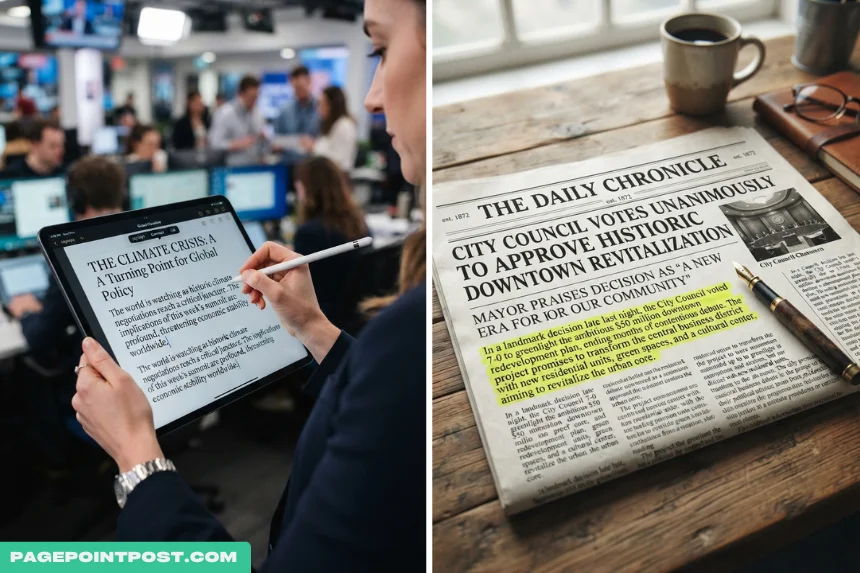
A lede in journalism is the opening sentence or opening section of a news story. Its job is to give readers the most important information quickly and make them want to keep reading. In a straight news story, the lede usually answers the biggest parts of the story first: who, what, when, where, why, and sometimes how.
You may also see the word written as lead. Both words refer to the beginning of a story, but many journalists use lede as newsroom shorthand. Merriam-Webster explains that “lede” refers to the introductory section of a news story and often appears in the phrase “bury the lede.”
A strong lede helps readers understand the story immediately. A weak lede delays the main point, adds clutter, or starts with details that matter less than the news itself.
Lede Meaning in Journalism
In journalism, a lede introduces the story’s most important fact, angle, or event. It tells readers why the story matters.
A lede can do several things at once:
- Summarize the main news
- Set the tone of the story
- Identify the most important person, place, or action
- Give readers a reason to continue
- Point the story in a clear direction
In hard news, the lede often gives the main fact right away. In features, profiles, essays, and narrative journalism, the lede may open with a scene, quote, question, image, or surprising detail before moving to the central point.
Lede vs. Lead: What Is the Difference?
Lede and lead usually mean the same thing in journalism: the beginning of a story.
The spelling difference comes from newsroom tradition. Merriam-Webster notes that lead served as the preferred spelling for many years, while lede later grew as newsroom jargon. One common explanation says journalists used “lede” to avoid confusion with lead, the metal once used in printing. Merriam-Webster also notes that its earliest examples of “lede” come from the 1970s, around the time Linotype machines started disappearing from newsrooms.
Poynter has also covered the debate and explains that writers still argue over “lead” versus “lede.”
For modern writers, the practical rule is simple: use lede when you want the journalism term, especially in media writing, editing, or newsroom contexts. Use lead if your publication’s style guide prefers it.
What Does “Bury the Lede” Mean?
To bury the lede means to hide the most important part of a story too far down in the article.
For example, imagine a local government story begins with three paragraphs about a long meeting, then finally says the city approved a major tax increase. That story buries the lede because the tax increase matters most to readers.
A better version starts with the main news:
The city council approved a property tax increase Tuesday night to fund road repairs and emergency services.
That sentence gives readers the core information immediately. It also makes the rest of the story easier to understand.
Why the Lede Matters
The lede matters because readers decide quickly whether a story deserves their time. A clear opening helps them understand the news before they see background, quotes, or extra detail.
A good lede also helps the writer. Once the lede identifies the main point, the rest of the story can follow a logical structure. The reporter can add context, evidence, quotes, and explanation without losing the reader.
Purdue OWL explains that the inverted pyramid places the most fundamental facts at the top of a story, usually in the lead paragraph, then arranges details from most important to least important.
The Five Ws and One H
Many journalism ledes answer some or all of these questions:
| Question | What it tells readers |
|---|---|
| Who? | The person, group, company, agency, or community involved |
| What? | The action, decision, event, problem, or discovery |
| When? | The date, time, deadline, or timeframe |
| Where? | The location or setting |
| Why? | The reason, cause, motive, or importance |
| How? | The method, process, impact, or result |
A lede does not always need to answer all six. In fact, a sentence that tries to include everything can feel overloaded. The writer should choose the most important details and save the rest for the next few paragraphs.
Types of Ledes in Journalism
Journalists use different ledes depending on the story type, audience, and purpose.
Summary Lede
A summary lede gives the main facts quickly. Reporters use it often in breaking news and hard news.
Example:
A federal judge blocked the new housing rule Monday, delaying enforcement while the court reviews a legal challenge from state officials.
This lede works because it tells readers what happened, who acted, when it happened, and why the decision matters.
Delayed Lede
A delayed lede starts with a detail, scene, or moment before revealing the main point. Feature writers use it when they want to build interest before stating the larger story.
Example:
The lights stayed on all night at the small bakery on Main Street. By sunrise, volunteers had packed 2,000 meals for families displaced by the flood.
This opening creates a scene, then points to the wider story.
Anecdotal Lede
An anecdotal lede opens with a short story about one person or moment. Writers often use it in profiles, human-interest stories, and long-form features.
Example:
Maria Lopez kept her son’s hospital bracelet in her wallet for three years. This week, she carried it to the state capitol as lawmakers debated a bill that could change pediatric care funding.
This lede works because one personal detail leads readers into a broader policy issue.
Question Lede
A question lede begins with a question. Writers should use it carefully because readers often prefer a clear statement over a question.
Example:
What happens when a rural town loses its only grocery store?
This lede can work when the article immediately answers the question and builds curiosity without sounding vague.
Scene-Setter Lede
A scene-setter lede places readers inside a moment.
Example:
Rainwater ran through the school hallway as teachers stacked books on desks and parents waited outside with umbrellas.
This style works well when atmosphere helps readers understand the story.
How to Write a Strong Lede
A strong lede starts with judgment. The writer must decide what readers need to know first.
Use this process:
- Identify the main news or central point.
- Ask why readers should care.
- Choose the most important facts.
- Write one clear opening sentence.
- Remove extra words.
- Check whether the story still makes sense if readers only read the first paragraph.
A strong news lede usually stays specific. Instead of writing, “A meeting was held Tuesday,” write what happened at the meeting. Instead of writing, “Officials discussed a plan,” say what the plan would do.
Common Lede Mistakes
Starting Too Slowly
Some writers begin with background that belongs later. Readers should not have to wait several paragraphs to learn the main point.
Weak example:
The city council met Tuesday night for its regular monthly meeting at City Hall.
Stronger example:
The city council approved a $12 million road repair plan Tuesday night after months of complaints from residents.
Adding Too Many Details
A crowded lede can confuse readers. Keep the opening focused, then use the next paragraph for supporting facts.
Weak example:
After a long meeting that included public comments, budget questions, several amendments, and a final vote just before midnight, the school board approved a new attendance policy Tuesday.
Stronger example:
The school board approved a new attendance policy Tuesday after parents raised concerns about chronic absences.
Using Vague Language
Words like “issue,” “situation,” “matter,” and “development” often weaken a lede.
Weak example:
Officials addressed an important issue Tuesday.
Stronger example:
County officials approved emergency funding Tuesday to repair three bridges damaged by flooding.
Hiding the Most Important Point
A lede should not force readers to dig for the main news. Put the strongest fact near the beginning when the story calls for it.
Lede Examples
Hard News Example
Police arrested a 32-year-old man Monday after a downtown bank robbery led to a two-hour road closure.
This lede gives the main event, the person involved, the timing, and the public impact.
Business News Example
The company plans to cut 400 jobs this summer as it closes two factories and shifts production overseas.
This lede avoids vague corporate language and gives readers the key change.
Sports Example
The Lions won their first championship in 18 years Sunday after a last-minute goal sealed a 3-2 victory.
This lede gives the result, the importance, and the dramatic moment.
Feature Example
Every morning, James Carter unlocks the same library door his grandmother opened during the city’s first literacy campaign 50 years ago.
This lede does not give every fact at once, but it creates a human reason to keep reading.
Lede in Digital Journalism
Digital journalism still needs strong ledes. Online readers often scan quickly, open stories on mobile phones, and decide within seconds whether to continue.
A digital lede should:
- State the main point clearly
- Avoid filler
- Match the headline
- Use natural language
- Give enough context for readers who arrive from social media, newsletters, or news apps
A lede should never mislead readers for clicks. Reuters’ journalism standards stress accuracy, fairness, transparency, and freedom from bias. Those values apply to the opening of a story as much as to the rest of the article.
FAQs
What is a lede in simple terms?
A lede is the opening sentence or opening paragraph of a news story. It gives readers the most important information and encourages them to keep reading.
Is lede the same as lead?
Yes, in journalism, lede and lead usually mean the same thing. Many journalists use “lede” as newsroom jargon for the opening of a story.
Why do journalists spell it lede?
Many journalists use “lede” to distinguish the story opening from “lead,” the metal once used in printing. Merriam-Webster notes that the spelling became newsroom jargon and gained wider use later.
What does bury the lede mean?
Bury the lede means delaying or hiding the most important part of a story under less important information.
How long should a lede be?
A hard-news lede often works best in one clear sentence. Feature ledes can run longer, but they still need focus and purpose.
What makes a good lede?
A good lede gives readers the central point, uses clear language, avoids clutter, and makes the rest of the story easier to follow.
Conclusion
A lede in journalism is the opening that tells readers what matters most. Some writers spell it “lead,” while many journalists prefer “lede,” but both words point to the same idea: start the story clearly. A strong lede respects the reader’s time, highlights the main point, and gives the article a clear direction from the first sentence.
Discover more on our website about does benjamin hall have a glass eye