



A narwhal tusk is one of the most recognizable structures in the Arctic. It looks like a long, ivory-colored horn extending from the animal’s head, yet it is actually a specialized tooth. For centuries, this unusual feature has inspired myths, scientific questions, artwork, and even the medieval legend of the unicorn.
Modern research gives us a much clearer picture. Narwhals use their tusks in ways that connect social behavior, sensory biology, reproduction, and life in the Arctic Ocean. However, scientists still do not have a complete answer to every question surrounding the tusk.
The narwhal itself (Monodon monoceros) is a toothed whale that lives primarily in Arctic waters. Most males develop a prominent tusk, while some females also grow one. In rare cases, an individual can develop two tusks.
So, what makes this tooth so unusual? How does it grow? Does a narwhal actually use it to fight? And why does the animal need such a remarkable structure in the first place?
This guide explores the anatomy, function, growth, cultural history, conservation concerns, and scientific importance of the narwhal tusk.
What Is a Narwhal Tusk?
A narwhal tusk is a modified upper canine tooth that grows outward through the animal’s upper lip. It usually develops on the left side. Unlike ordinary mammalian teeth, however, the tusk has an unusual structure and sensory system.
According to the Smithsonian’s National Zoo & Conservation Biology Institute, narwhals are Arctic whales with a distinctive long tusk, particularly among males. The tusk can become several meters long in a mature animal.
The tusk is made primarily of dentin rather than the dense enamel that covers most exposed human teeth. Its surface also contains microscopic channels and structures that distinguish it from an ordinary tooth.
Most importantly, the tusk does not grow like a dead piece of ivory. It remains biologically connected to the narwhal.
That fact changed how scientists understood the structure.
For a long time, people treated the tusk primarily as a weapon or ornament. Research now suggests that it can serve multiple purposes. Scientists have observed tusk use during social interactions, and laboratory studies have also demonstrated that the tooth contains sensory structures capable of responding to changes in the surrounding environment.
Therefore, the tusk appears to be more than a simple spear.

How Long Can a Narwhal Tusk Get?
The size of a narwhal tusk varies considerably. Some adult males develop tusks approaching three meters in length, although individual growth differs.
The NOAA Fisheries narwhal profile provides background on narwhal biology, habitat, and conservation. The species generally lives in Arctic and sub-Arctic waters, where sea ice strongly influences its movements.
A long tusk requires substantial growth over time. Because narwhals can live for decades, an older animal may carry a remarkably large structure.
The tusk also has a characteristic spiral shape. The spiral typically twists counterclockwise when viewed from the animal’s body toward the tip.
Interestingly, the spiral does not mean that the tooth grows as a rigid spiral object from the beginning. Instead, the structure develops through asymmetric growth and the physical organization of dentin.
The result is one of the most distinctive teeth in the animal kingdom.
Why Do Narwhals Have Tusks?
This question sounds simple, but scientists do not have one universally accepted answer.
The tusk probably performs several functions rather than serving a single purpose.
One major explanation involves sexual selection. Adult males frequently possess large tusks, and males sometimes engage in a behavior known as “tusking.” During tusking, two narwhals bring their tusks together and may rub or cross them.
Researchers have suggested that these interactions could help males assess one another or display physical condition.
The tusk may therefore act partly as a social signal.
At the same time, observations indicate that narwhals can use their tusks to interact with prey and their environment. Scientists have documented behavior suggesting that a narwhal can use its tusk to stun fish.
However, it would be inaccurate to describe the tusk simply as a hunting spear.
Narwhals possess other adaptations that help them survive Arctic waters. Their bodies, swimming abilities, diving behavior, and echolocation all contribute to feeding success.
As a result, the tusk likely represents one component of a much larger survival strategy.
Why Is the Tusk Usually Found in Males?
The most prominent tusks occur in males, which has led scientists to investigate sexual selection as a major driver of tusk evolution.
Male narwhals can grow very large tusks, while females usually lack them or possess a much smaller version. Because males compete socially and reproductively, a visible structure such as a tusk can provide information about an individual’s condition.
This pattern resembles sexual traits found in many other animals.
For example, male deer grow antlers, some birds develop elaborate feathers, and certain seals develop enlarged features used during competition or display. These structures can impose biological costs while also providing reproductive advantages.
The narwhal tusk fits this broader evolutionary pattern, although its exact role remains complex.
Researchers cannot simply assume that a larger tusk always means a stronger or more successful male. Environmental conditions, age, health, genetics, and social relationships can all influence an animal’s biology.
Therefore, scientists treat tusk size as an important trait rather than a simple scorecard of fitness.
Can Female Narwhals Have Tusks?
Yes.
Although the large tusk is strongly associated with males, some female narwhals grow tusks. Most females do not develop the dramatic structure commonly shown in photographs, but exceptions occur.
This fact matters because it complicates the idea that the tusk exists exclusively as a male weapon.
If the structure served only one function associated with male competition, its presence in some females would require additional explanation. Instead, researchers increasingly view the tusk as a multifunctional organ shaped by several evolutionary pressures.
The Animal Diversity Web at the University of Michigan provides taxonomic and biological information about Monodon monoceros.
Variation between individuals also reminds us that natural traits rarely follow absolute rules.
Biology works through probabilities, inheritance, development, and environmental influences.
Is a Narwhal Tusk Actually a Tooth?
Yes. A narwhal tusk is a tooth.
More specifically, it is an elongated upper tooth that normally emerges from the left side of the mouth.
This detail makes the narwhal particularly fascinating because the structure does not resemble an ordinary tooth. It can extend far beyond the animal’s body and form a distinctive spiral.
The tooth also differs internally from many familiar mammalian teeth.
Instead of relying on a thick enamel coating over the exposed surface, the tusk consists largely of dentin. Researchers have found that the tooth contains an extensive network of microscopic tubules.
Those structures help explain why scientists became interested in the tusk as a possible sensory organ.
The tooth is not simply an inert object attached to the skull.
It remains connected to living tissues and contains nerves and blood vessels. Consequently, the narwhal can receive information through the structure.
That discovery transformed scientific thinking about what the tusk might do.
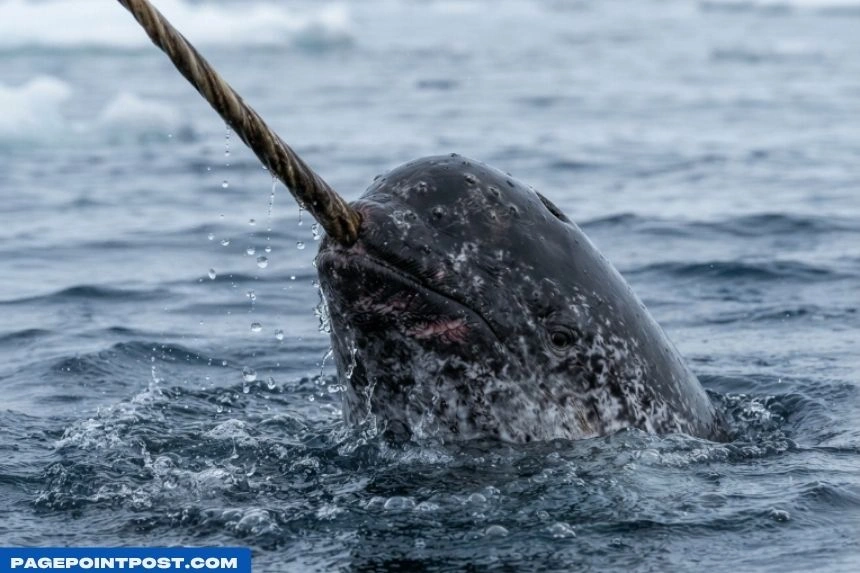
How Does a Narwhal Use Its Tusk?
Scientists have documented several possible and observed uses.
Social Interaction
Tusking is one of the best-known behaviors associated with adult narwhals. Two animals may align their tusks and rub them together.
For years, people interpreted this behavior as combat. However, observations suggest that tusking does not always involve aggressive fighting.
Instead, it may function as a form of social communication, display, competition, or assessment.
The tusk therefore becomes part of the narwhal’s social life.
Hunting
Researchers have also observed narwhals striking fish with their tusks.
A famous example involves narwhals interacting with Arctic cod. Rather than using the tusk primarily to stab prey, the animal can move the tusk toward a fish and apparently stun it before consuming it.
This behavior demonstrates that the tusk can have a practical feeding function.
Nevertheless, scientists should not assume that every narwhal routinely hunts this way.
Wild animals often use structures differently depending on circumstances.
Environmental Sensing
The sensory nature of the tusk may represent its most unusual biological feature.
Research led by scientists studying narwhal tooth anatomy has shown that the tusk contains structures capable of transmitting environmental information. The tooth’s exposed surface lacks the conventional protective arrangement people might expect from a mammalian tooth.
This unusual design may allow the narwhal to detect aspects of its environment, including chemical and physical changes.
However, researchers continue to investigate exactly how important this sensory ability is in the animal’s daily life.
What Does a Narwhal Tusk Feel Like?
A living narwhal tusk is not simply hard ivory.
Its outer surface contains microscopic structures, and the underlying dentin remains biologically active. The tooth’s unusual anatomy allows environmental signals to reach internal tissues.
That design creates an important evolutionary trade-off.
A highly sensitive tooth may provide useful information, but it also needs to survive physical stress in cold marine environments.
Narwhals have evolved within a specialized Arctic ecosystem. Their bodies must cope with freezing water, seasonal ice, deep dives, changing prey availability, and rapid environmental shifts.
The tusk forms part of that larger adaptation.
How Fast Does a Narwhal Tusk Grow?
Tusk growth occurs over many years.
Scientists can study growth layers and chemical signatures in narwhal teeth to learn about the animal’s age, diet, habitat, and environmental exposure.
This makes the tusk valuable not only to the narwhal but also to researchers.
A growing tusk effectively records aspects of the animal’s life.
Researchers can examine isotopes and other chemical indicators preserved in dental material. These measurements can reveal information about where the animal lived and what it encountered.
In that sense, a narwhal tusk can function as a biological archive.
The Smithsonian Ocean portal offers additional information about narwhal biology and the Arctic ecosystem.
What Is the Spiral on a Narwhal Tusk?
The spiral is one of the tusk’s most recognizable characteristics.
It develops because of the way the tooth grows. Rather than producing a smooth cylindrical surface, growth creates a distinctive helical pattern around the tusk.
The spiral may help strengthen the long tooth, although scientists continue to study the precise mechanical consequences of its structure.
It also gives every large tusk a visually distinctive appearance.
Historically, this unusual spiral played a major role in the development of the unicorn myth. European collectors and traders encountered narwhal tusks but did not always know their true origin.
Because the tooth resembled a magical horn, people sometimes sold it as a unicorn horn.
How Narwhal Tusks Became “Unicorn Horns”
Before modern zoology, European societies had limited knowledge of distant Arctic wildlife.
Narwhals lived far from European population centers. Their tusks entered trade networks, however, and people valued them as strange and mysterious objects.
A long, spiraled tooth could easily look like the horn of a mythical animal.
During the Middle Ages and Renaissance, supposed unicorn horns became valuable objects. Some rulers and wealthy collectors possessed them as curiosities or symbols of status.
The truth eventually became clearer as naturalists studied Arctic animals.
The supposed unicorn horn turned out to be a narwhal tooth.
This historical connection remains one of the most famous examples of how incomplete biological knowledge can shape mythology.
The Natural History Museum in London provides accessible information about narwhals and the history surrounding their famous tusks.
Why Were Narwhal Tusks Historically Valuable?
Narwhal tusks had value because of their rarity, appearance, and association with unicorn mythology.
People carved some tusks into decorative objects. Others became collector’s items.
However, historical demand also created pressure on narwhal populations.
The international trade in wildlife products has changed substantially over time. Today, laws and agreements regulate many forms of wildlife trade, and the legal status of narwhal products depends on the jurisdiction and circumstances.
The Convention on International Trade in Endangered Species of Wild Fauna and Flora (CITES) explains how international wildlife trade is regulated through its treaty framework.
Anyone considering the purchase, sale, import, or export of a narwhal tusk should therefore check current laws and documentation rather than relying on assumptions about legality.
Are Narwhal Tusks Legal to Own?
There is no single worldwide answer.
Wildlife laws vary by country, region, Indigenous rights framework, and the origin of the specimen. International trade can involve additional restrictions.
For that reason, ownership and trade questions require careful documentation.
A legally obtained historical specimen may have a very different status from a recently harvested tusk. Similarly, a product acquired legally in one jurisdiction may face restrictions when someone attempts to transport it internationally.
The safest approach involves checking current government regulations and provenance records.
In the United States, for example, federal wildlife laws and international trade requirements can affect marine mammal products. The U.S. Fish & Wildlife Service provides information about the Marine Mammal Protection Act and related protections.
Because regulations can change, readers should verify requirements with the relevant government authority before making a transaction.

How Big Is a Narwhal Compared With Its Tusk?
Narwhals are medium-sized whales, generally reaching several meters in body length.
A fully developed tusk can therefore represent a substantial proportion of an adult male’s body length.
That creates an extraordinary visual effect. The tusk projects forward from the animal’s head while the whale swims beneath Arctic sea ice.
Yet the narwhal does not simply carry the tusk as dead weight.
The structure integrates with the skull, surrounding tissues, nervous system, and circulatory system.
Evolution has consequently produced a remarkable combination of length, flexibility, sensory capacity, and mechanical strength.
What Happens If a Narwhal Breaks Its Tusk?
A broken tusk does not automatically mean that the animal dies.
Narwhals can survive tusk damage, and observations of wild animals show that tusks can become chipped, damaged, or broken.
Because the tusk remains connected to living tissue, however, significant damage can create biological risks.
A damaged tooth may expose internal structures. The severity depends on the nature and location of the injury.
Narwhals also have another important advantage: the tusk is not their only tooth.
Their mouth contains other teeth, although their feeding strategy differs significantly from that of humans and many other mammals.
Scientists continue to examine how tusk damage affects individual animals in the wild.
Why Are Narwhals Important to Arctic Ecosystems?
The narwhal occupies a specialized ecological niche.
It spends much of its life in Arctic and sub-Arctic waters, where seasonal sea ice strongly influences movement, feeding, migration, and access to breathing areas.
Because narwhals depend so heavily on Arctic conditions, researchers often consider them useful indicators of environmental change.
Changes in sea ice can alter where narwhals travel and where prey becomes available. Increasing human activity in Arctic waters can also introduce additional disturbances.
The species faces a changing environment as Arctic temperatures rise.
The IUCN Red List provides conservation information for Monodon monoceros and summarizes the species’ current assessment.
Understanding narwhals therefore means understanding more than one unusual tooth. It also means examining the health and stability of Arctic marine ecosystems.
What Threats Do Narwhals Face?
Narwhals face several environmental pressures.
Climate Change
Arctic warming can alter sea-ice patterns, prey distributions, ocean conditions, and migration routes.
Because narwhals have strong relationships with sea ice, rapid environmental change may affect their behavior and habitat.
Human Activity
Shipping, industrial development, underwater noise, pollution, and increased Arctic access can create additional challenges.
As sea ice retreats in some areas, previously difficult-to-reach Arctic waters may become more accessible to human activities.
That change can produce both economic opportunities and conservation concerns.
Hunting Pressure
Narwhals have long been hunted by Arctic communities, including Indigenous peoples with deep cultural and subsistence relationships with the species.
It is important to discuss this subject carefully.
Indigenous hunting traditions cannot simply be equated with commercial wildlife exploitation. Different communities operate within distinct cultural, legal, ecological, and management frameworks.
Conservation policies therefore need to consider both wildlife sustainability and Indigenous rights.
Do Narwhals Use Their Tusks to Fight?
Sometimes tusks may play a role in competition, but calling them weapons oversimplifies the behavior.
During tusking, narwhals can bring their tusks together in a controlled interaction. Researchers have observed these encounters among males.
The behavior may communicate information about social status, physical condition, or reproductive competition.
Still, the tusk does not function like a sword in constant combat.
Narwhals generally do not need to fight predators with their tusks. Their primary defenses include swimming behavior, group dynamics, and their ability to inhabit challenging Arctic environments.
The tusk’s social role may therefore be more important than its role as a weapon.
Can a Narwhal Have Two Tusks?
Yes, although two-tusked narwhals are rare.
Most tusked males have a single left tusk. In occasional individuals, the corresponding right tooth also develops outward.
A two-tusked narwhal therefore represents an unusual developmental variation rather than the normal condition.
This rarity has contributed to the fascination surrounding narwhals. A double-tusked individual can look even more extraordinary than the typical animal.
Scientists study such variation because it can reveal information about tooth development, genetics, and evolutionary history.
What Can Scientists Learn From a Narwhal Tusk?
A narwhal tusk can preserve a record of the animal’s life.
Researchers can analyze chemical elements and isotopes in the tooth. These measurements can provide clues about diet, movement, environmental conditions, and exposure to pollutants.
The basic idea resembles the use of tree rings or ice cores as environmental records.
A tree records aspects of its growth conditions. An ice core preserves evidence of past atmospheric conditions. Likewise, a narwhal tusk can preserve biological and environmental information over time.
This makes tusks especially valuable for long-term ecological research.
Scientists can potentially investigate historical changes by examining tusks from different periods.
The National Oceanic and Atmospheric Administration also provides educational material that helps place narwhals within the broader Arctic marine environment.
Narwhal Tusk vs. Elephant Tusk: What Is the Difference?
Both structures are called tusks, but they evolved in very different animals.
An elephant tusk is a modified incisor. A narwhal tusk is a modified tooth that emerges from the upper jaw.
Elephant tusks usually occur in both sexes in African elephants, although Asian elephant tusk development differs between males and females.
Narwhal tusks, by contrast, show a strong male bias.
Their biological roles also differ.
Elephant tusks can help with digging, stripping bark, moving objects, defense, and competition. Narwhal tusks appear to have important social and sensory functions, with evidence also supporting their use during interactions with prey.
The comparison demonstrates that evolution can transform teeth into very different structures depending on environmental pressures.
Narwhal Tusk Facts at a Glance
| Feature | Narwhal Tusk |
| Biological identity | Modified tooth |
| Typical location | Upper left jaw |
| Most common in | Adult males |
| Female tusks | Uncommon but possible |
| Shape | Long and spiraled |
| Main material | Dentin |
| Sensory structures | Yes |
| Social role | Supported by observed tusking behavior |
| Hunting-related use | Observed in some feeding interactions |
| Maximum size | Can approach several meters |
| Conservation relevance | Important indicator of Arctic ecological change |
These characteristics explain why the tusk remains such an important subject in marine biology.
Frequently Asked Questions About the Narwhal Tusk
1. Is a narwhal tusk a horn or a tooth?
A narwhal tusk is a tooth, not a true horn. It develops from a tooth in the upper jaw and can grow several meters long.
2. Do all narwhals have tusks?
No. Most prominent tusks occur in males, while many females do not develop them. Some females can grow tusks, and rare individuals develop two.
3. How long can a narwhal tusk become?
A large adult tusk can approach three meters in length, although size varies among individuals.
4. Why does a narwhal tusk spiral?
The spiral results from the distinctive growth pattern of the tooth. Its helical appearance is one of the most recognizable characteristics of the species.
5. Can narwhals use their tusks to hunt?
Yes, researchers have observed narwhals using tusks during interactions with fish. The tusk can apparently help stun prey, although it is not simply a spear used for every hunt.
6. Can a female narwhal have a tusk?
Yes. Females occasionally develop tusks, although large tusks are much more common among males.
7. Is a narwhal tusk sensitive?
Yes. The tusk contains living tissues and sensory structures. Researchers have found evidence that its unusual anatomy allows environmental information to reach the nervous system.
8. Why did people associate narwhal tusks with unicorns?
European societies historically encountered narwhal tusks without knowing their true biological origin. Their long, spiraled shape resembled descriptions of mythical unicorn horns, which helped create a valuable trade in supposed unicorn material.
9. Can a narwhal survive if its tusk breaks?
A narwhal can survive tusk damage, although serious injury may affect living tissues inside the tooth. The consequences depend on how and where the tusk breaks.
10. Are narwhal tusks legal to buy or sell?
Legality depends on the country, origin of the specimen, applicable wildlife laws, and whether international trade is involved. Buyers should verify provenance and current government requirements before purchasing or transporting a tusk.
The Narwhal Tusk Is More Than an Arctic “Horn”
The narwhal tusk looks simple from a distance: a long tooth projecting from a whale’s head.
Up close, however, it tells a much richer story.
It reveals how evolution can transform a tooth into a sensory, social, and potentially feeding-related structure. It also shows how human cultures can misunderstand unfamiliar wildlife and turn a biological feature into a mythological object.
Today, the tusk has another important role. It provides scientists with a valuable source of information about individual narwhals and the Arctic environments in which they live.
At the same time, narwhal conservation requires attention to rapidly changing sea-ice conditions, human activity, sustainable wildlife management, and the rights and traditions of Arctic Indigenous communities.
Ultimately, the narwhal’s famous tusk is not merely an unusual body part. It is a window into the animal’s evolution, behavior, history, and environment.
For that reason, understanding the narwhal tusk means understanding the remarkable relationship between one specialized Arctic whale and the ecosystem it calls home.
Read More At Page Point Post