


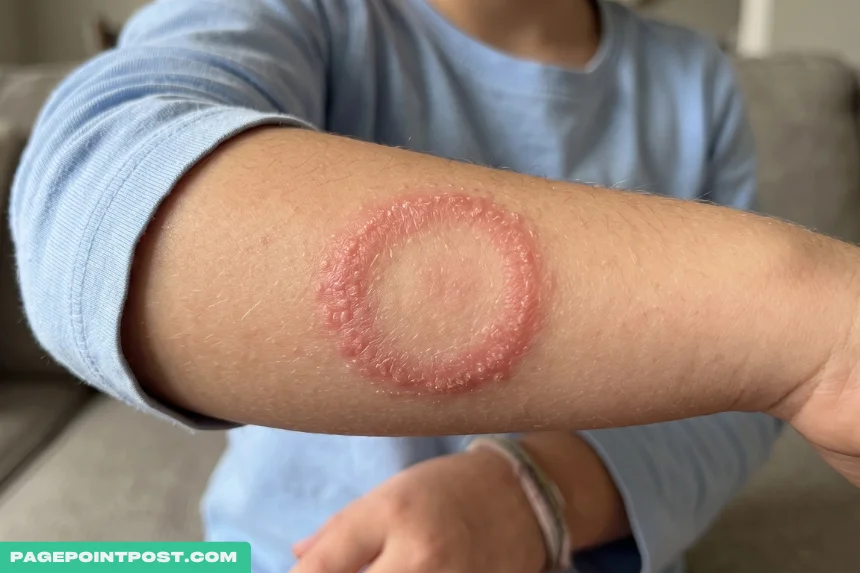
Several skin conditions can produce a round, red, brown or scaly patch that resembles ringworm. Common possibilities include nummular eczema, granuloma annulare, pityriasis rosea, psoriasis and contact dermatitis. An expanding Lyme disease rash can also appear circular, although it usually behaves differently and needs prompt medical attention.
Ringworm is a contagious fungal infection, not an infection caused by a worm. On most areas of the body, it produces a slowly enlarging patch with a raised, scaly edge. The center may become clearer as the rash expands. However, ringworm does not always form a perfect ring, and its color can appear red or pink on lighter skin and brown or gray on darker skin.
Because treatments for fungal infections, eczema and bacterial or immune-related conditions are different, appearance alone is not enough to make a reliable diagnosis.
Medical note: This guide provides general information and cannot diagnose a rash. Consult a healthcare professional about a new, persistent, spreading or unexplained skin change.
What Does Ringworm Usually Look Like?
Ringworm of the body, medically known as tinea corporis, is caused by dermatophyte fungi. It commonly appears as one or more roundish patches with a raised, scaly or wavy border. The edge may expand outward while the center begins to clear, creating the familiar ring-like appearance. Itching can be mild or intense.
Ringworm can spread through direct contact with an infected person or animal or by touching contaminated surfaces and personal items. Similar fungal infections are called athlete’s foot when they affect the feet and jock itch when they affect the groin.
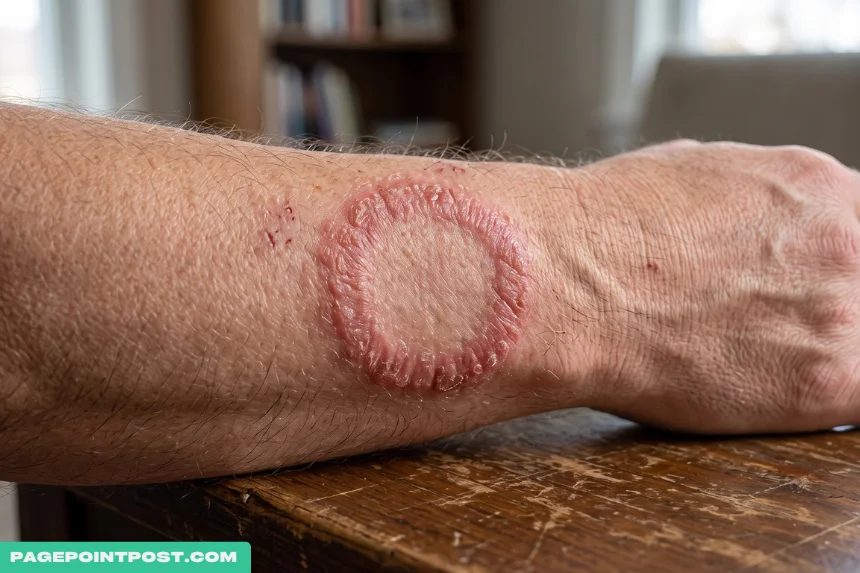
Clues that make ringworm more likely include:
- A raised, scaly outer edge
- Gradual outward growth
- Clearing toward the center
- Itching
- More patches appearing over time
- Recent contact with an infected person or animal
- Participation in wrestling or another close-contact sport
- Sharing towels, clothing, bedding or sports equipment
None of these features proves that a rash is fungal. Eczema, psoriasis and other inflammatory conditions can closely resemble ringworm, particularly after the rash has been scratched or treated with the wrong cream.
Conditions That Can Look Like Ringworm
| Condition | Typical appearance | How it often differs from ringworm | Contagious? |
|---|---|---|---|
| Nummular eczema | Very itchy, coin-shaped scaly patches | Often uniformly dry or crusted rather than having an active outer border | No |
| Granuloma annulare | Smooth ring made of firm bumps | Usually has little or no scale and may not itch | No |
| Pityriasis rosea | One oval patch followed by many smaller patches | Usually spreads across the trunk in a recognizable pattern | No |
| Psoriasis | Thick, well-defined scaly plaques | Often recurs and may affect the scalp, elbows, knees or nails | No |
| Lyme disease rash | Gradually expanding round or oval patch | Usually not scaly and is rarely itchy or painful | No |
| Contact dermatitis | Itchy, burning or blistering rash | Often matches the area exposed to an irritant or allergen | No |
| Erythema multiforme | Multiple target-shaped spots | Usually has several concentric rings and appears symmetrically | No |
| Cutaneous lupus | Ring-like or scaly sun-sensitive patches | Often appears on sun-exposed skin and may follow sun exposure | No |
1. Nummular Eczema
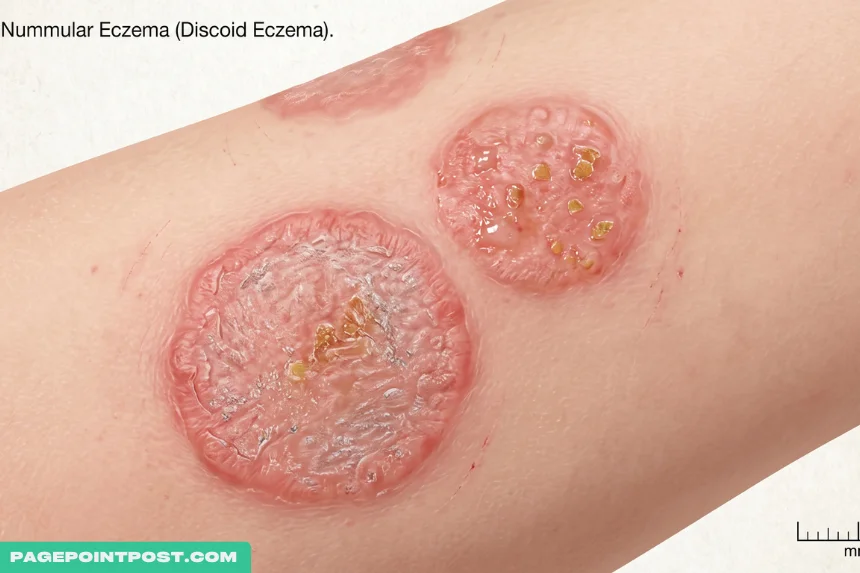
Nummular eczema, also called discoid eczema or nummular dermatitis, causes round or oval patches that can look remarkably similar to ringworm. The word nummular means coin-shaped.
The rash may begin as tiny bumps or blister-like sores that merge into a raised patch. These patches are often scaly, crusted and intensely itchy. They can appear pink or red on lighter skin and brown, violet or lighter than the surrounding area on darker skin. The skin between the patches is often very dry.
How it differs from ringworm
Nummular eczema often has inflammation and scale across the entire patch. Ringworm is more likely to have a particularly active, raised or scaly outer edge with relative clearing in the middle.
Eczema patches may also:
- Burn or sting
- Ooze or develop crusts
- Occur on very dry skin
- Return in the same areas
- Become worse in cold or dry weather
The center of a nummular eczema patch can flatten as it heals, so central clearing does not automatically mean a rash is ringworm. A dermatologist may need to test a skin scraping when the distinction is unclear.
2. Granuloma Annulare
Granuloma annulare is a noncontagious skin condition that frequently forms a circular or ring-shaped patch. It often affects the hands, feet, arms or legs, although it can occur elsewhere.
The ring is typically formed by small, firm bumps that join together. The bumps may be skin-colored, pink, reddish or violet. Most cases produce little or no pain or itching.
How it differs from ringworm
The most useful clue is the texture. Granuloma annulare is generally smooth rather than flaky and lacks the prominent scale usually seen at the edge of ringworm.
It is also:
- Not caused by a fungus
- Not contagious
- Often painless
- More likely to feel firm or bumpy
- Frequently free of crusting or surface scale
Many cases eventually clear without treatment, although this can take months or longer. A dermatologist may examine or biopsy an unusual lesion because other conditions can create a similar ring.
3. Pityriasis Rosea
Pityriasis rosea often starts with one round or oval patch known as a herald patch. During the first few days, this single patch can easily be mistaken for ringworm.
Within about one or two weeks, smaller patches typically appear on the trunk, arms or legs. On the back, they may follow the natural lines of the ribs and form a pattern sometimes compared to branches on a Christmas tree. The spots may itch, especially when the skin becomes warm during exercise or a hot shower.
How it differs from ringworm
Ringworm may spread by forming additional separate fungal patches, but pityriasis rosea tends to follow a recognizable sequence:
- One larger herald patch appears.
- It grows for several days.
- Numerous smaller patches develop.
- The rash gradually clears, usually within six to eight weeks.
Pityriasis rosea is not contagious. It may leave temporary lighter or darker spots after the active rash disappears, particularly on deeply pigmented skin.
A professional diagnosis is important because medication reactions and some infections can produce a similar widespread rash.
4. Psoriasis
Psoriasis is an immune-mediated condition that causes skin cells to accumulate more quickly than usual. Plaque psoriasis commonly produces dry, thick and raised patches covered with scale. The patches can be round or curved and may resemble a fungal rash.
Psoriasis commonly affects the:
- Elbows
- Knee
- Scalp
- Lower back
- Area behind the ears
- Nails
The plaques may appear red with silvery-white scale on lighter skin. On darker skin, they can appear violet, gray, dark brown or reddish brown, sometimes with gray scale.
How it differs from ringworm
Psoriasis plaques are often thicker and more evenly scaly than ringworm. They may occur in matching areas on both sides of the body and tend to return over time.
Other clues include:
- Scalp flaking that extends beyond the hairline
- Nail pitting or crumbling
- Several similar plaques on the elbows or knees
- A personal or family history of psoriasis
- Joint pain or stiffness
Because ringworm can also be scaly and itchy, a clinician may take a skin scraping before prescribing treatment. The Centers for Disease Control and Prevention notes that ringworm can be difficult to distinguish from psoriasis and eczema by examination alone.
5. Lyme Disease Rash
The early Lyme disease rash, called erythema migrans, may form a red or discolored circle that resembles ringworm. It develops after the bite of an infected blacklegged tick and gradually expands over several days.
The rash does not always look like a classic bull’s-eye. It may be uniformly colored, oval, irregular or darker in the center. It can feel warm, but it is rarely itchy or painful and is generally not scaly.
How it differs from ringworm
Ringworm usually has a scaly surface and a raised advancing edge. Erythema migrans generally:
- Expands relatively quickly
- Has little or no scale
- Is rarely itchy
- Is rarely painful
- May appear three to 30 days after a tick bite
- Can occur with fever, fatigue, headache, muscle aches or swollen lymph nodes
The CDC reports that erythema migrans occurs in approximately 70% to 80% of people with Lyme disease. It can grow to 12 inches or more across, and not everyone remembers being bitten by a tick.
When to seek care
Contact a healthcare professional promptly if an expanding rash appears after possible tick exposure, particularly if you live in or recently visited an area where Lyme disease occurs. Do not wait for the rash to form a perfect bull’s-eye.
Lyme disease may require treatment based on the clinical appearance and exposure history. Blood tests can be falsely negative during the first few weeks, when an erythema migrans rash commonly appears.
6. Contact Dermatitis
Contact dermatitis develops when the skin reacts to an irritant or an allergen. A circular exposure—such as an adhesive patch, piece of jewelry, watch, medical sensor or topical product—can produce a round rash that resembles ringworm.
The affected skin may be intensely itchy, swollen, hot, tender or dry. Some reactions burn or sting. More severe cases can produce fluid-filled blisters, oozing and crusts.
How it differs from ringworm
Contact dermatitis often follows the shape or location of an exposure. Consider whether the rash appeared after contact with:
- A bandage or adhesive
- Fragranced skincare
- Detergent or cleaning products
- Nickel jewelry
- A new cosmetic
- Poison ivy, oak or sumac
- Rubber, latex or chemicals
- A topical medicine
Ringworm tends to enlarge outward over time. Contact dermatitis may instead remain limited to the exposed area or develop an irregular shape matching the object or substance.
Stopping exposure may allow the rash to improve, but ongoing or severe reactions should be assessed by a healthcare professional. Patch testing may be recommended when allergic contact dermatitis is suspected.
7. Erythema Multiforme
Erythema multiforme is an acute skin reaction, usually triggered by an infection and less commonly by a medicine. It creates distinctive target or iris lesions with several zones of color.
A typical spot may have a darker or blistered center surrounded by a pale ring and an outer red or discolored ring. Multiple lesions often appear symmetrically on the hands, feet, arms, legs or upper body.
How it differs from ringworm
Ringworm usually has one active, scaly outer border. Erythema multiforme produces true target lesions with several concentric zones and often appears in multiple matching locations.
Other symptoms may include:
- Mild fever
- Headache
- Joint aches
- Itching
- Blisters
- Sores on the lips or inside the mouth
- Eye irritation
Seek prompt care if a target-shaped rash occurs with mouth, eye or genital sores. Extensive blistering, skin peeling, severe pain or a reaction following a new medication requires urgent medical assessment.
8. Subacute Cutaneous Lupus
Subacute cutaneous lupus can cause ring-like or scaly patches, commonly on areas exposed to sunlight. The rash often develops on the upper chest, upper back, shoulders or arms and may resemble ringworm, eczema or psoriasis.
How it differs from ringworm
Clues that suggest a photosensitive condition rather than ringworm include:
- A rash that follows sun exposure
- Several patches on sun-exposed skin
- Little involvement beneath clothing
- Recurring flares after ultraviolet exposure
- Other unexplained symptoms, such as joint pain or unusual fatigue
Cutaneous lupus is not contagious. It requires medical evaluation because diagnosis may involve a physical examination, blood tests and sometimes a skin biopsy.
Can You Tell Ringworm Apart at Home?
You can look for patterns, but no single feature confirms the diagnosis.
Scale at the edge
A raised, scaly advancing edge supports ringworm. Smooth rings are more typical of granuloma annulare, while scale across the whole patch may point toward eczema or psoriasis.
Speed of growth
Ringworm tends to enlarge gradually. A rapidly expanding patch after possible tick exposure requires assessment for Lyme disease.
Number and distribution
One large patch followed by many smaller trunk lesions may indicate pityriasis rosea. Symmetrical thick plaques on the elbows or knees may suggest psoriasis. Multiple target lesions can occur with erythema multiforme.
Level of itching
Ringworm and eczema can both be very itchy. Granuloma annulare and an erythema migrans rash are often minimally itchy or not itchy at all.
Exposure history
Contact with an infected pet, wrestler or shared towel supports ringworm. Outdoor tick exposure raises concern for Lyme disease. A rash in the exact location of a new product or adhesive may be contact dermatitis.
These clues can guide the conversation with a clinician, but they should not replace testing when the diagnosis is uncertain.
How Doctors Confirm Whether a Rash Is Ringworm
A clinician may recognize a typical case during a skin examination. When the appearance is unclear, a sample can be collected by gently scraping the edge of the rash.
The sample may be examined under a microscope for fungal elements or sent to a laboratory. Hair or nail samples can also be tested when the scalp or nails are affected.
Additional tests may include:
- A fungal culture
- A skin biopsy
- Allergy patch testing
- Blood tests
- Evaluation for recent tick exposure
- Review of medicines and skincare products
Testing matters because treating eczema as ringworm may leave inflammation uncontrolled, while treating ringworm as eczema can allow the fungal infection to spread.
Avoid Steroid Cream on an Undiagnosed Ring-Shaped Rash
Do not treat a possible fungal rash with a steroid cream unless a healthcare professional has advised you to do so.
Steroids can reduce redness and itching temporarily while allowing the fungus to continue growing. The rash may become less recognizable, spread more widely or develop an unusual appearance. The CDC specifically advises against using steroid creams or ointments on ringworm or on a rash that might be ringworm.
Be cautious with combination products containing both an antifungal and a corticosteroid. A pharmacist, doctor or dermatologist can help you select an appropriate treatment once the likely cause is established.
Should You Try an Antifungal Cream?
Limited ringworm on ordinary body skin can often be treated with a nonprescription antifungal product. Common topical ingredients include clotrimazole, miconazole and terbinafine. Treatment usually continues for two to four weeks, depending on the medicine and its instructions.
Speak with a health care professional before self-treating when:
- You are not confident the rash is ringworm
- The rash is on the scalp, beard or nails
- It covers a large area
- It is on an infant
- You are pregnant
- You have diabetes or a weakened immune system
- The skin is blistered, infected or severely inflamed
- Previous treatment failed
- The rash improves with a steroid but returns or spreads
Ringworm of the scalp generally requires prescription antifungal medicine taken by mouth. Creams, powders and lotions do not adequately treat scalp infection.
When to See a Healthcare Professional
Arrange an appointment when a ring-shaped rash:
- Has an uncertain cause
- Continues to enlarge
- Does not improve with appropriate treatment
- Returns repeatedly
- Is painful rather than simply itchy
- Produces pus, warmth, swelling or red streaks
- Is associated with hair loss
- Appears on the scalp, face, genitals or nails
- Develops after starting a medicine
- Occurs in a person with a weakened immune system
Seek prompt medical attention for an expanding rash after possible tick exposure, especially when it occurs with fever, fatigue, headache, facial weakness, joint pain, palpitations or neurological symptoms.
Obtain urgent care for difficulty breathing, facial or tongue swelling, extensive blistering, skin peeling, eye involvement, severe pain or sores affecting several mucous membranes.
Frequently Asked Questions
What is most commonly mistaken for ringworm?
Nummular eczema is one of the most common look-alikes because it causes itchy, coin-shaped, scaly patches. Granuloma annulare and the first patch of pityriasis rosea can also closely resemble ringworm.
What looks like ringworm but does not itch?
Granuloma annulare is often smooth and causes little or no itching. An erythema migrans rash from Lyme disease is also rarely itchy or painful. A non-itchy expanding rash following possible tick exposure should be medically assessed.
Can eczema form a ring?
Yes. Nummular eczema creates round or oval patches and may develop some central clearing as it heals. It is often extremely itchy and may be dry, crusted or weepy.
Can psoriasis look circular?
Psoriasis plaques can have round or curved borders. They are usually thicker and more uniformly scaly than ringworm and may occur on both elbows, both knees, the scalp or the lower back. Nail changes can provide another clue.
Does every bull’s-eye rash mean Lyme disease?
No. Several conditions, including erythema multiforme and reactions to insect bites, can create target-like patterns. Conversely, Lyme disease does not always create a classic bull’s-eye. Its rash may be uniformly colored or irregular while continuing to expand.
Is a rash that looks like ringworm contagious?
It depends on the cause. Ringworm is contagious, but eczema, psoriasis, granuloma annulare, pityriasis rosea, Lyme disease and contact dermatitis are not spread from person to person. Until the cause is known, avoid sharing towels, clothing and bedding.
How quickly should antifungal cream work?
Improvement may begin before treatment is complete, but skin ringworm commonly requires two to four weeks of topical treatment. Follow the product instructions for the full recommended period. Contact a healthcare professional if the rash worsens, spreads or fails to improve.
Can a dermatologist diagnose a rash from a photograph?
A clear photograph may help with triage, but lighting, skin tone, texture and scale can be difficult to judge remotely. An in-person examination and skin scraping may be needed to distinguish a fungal infection from eczema, psoriasis or another condition.
Conclusion
Nummular eczema, granuloma annulare, pityriasis rosea, psoriasis, contact dermatitis and several other conditions can look like ringworm. The border’s texture, the distribution of the patches, the rate of growth and recent exposures provide helpful clues, but they do not guarantee an accurate diagnosis.
Avoid applying steroid cream to an unexplained ring-shaped rash because steroids can worsen or disguise a fungal infection. Seek professional care when the rash is rapidly expanding, persistent, painful, widespread, associated with tick exposure or accompanied by blisters, fever, hair loss or other concerning symptoms.
Read more about Is Listerine Bad for Your Teeth?